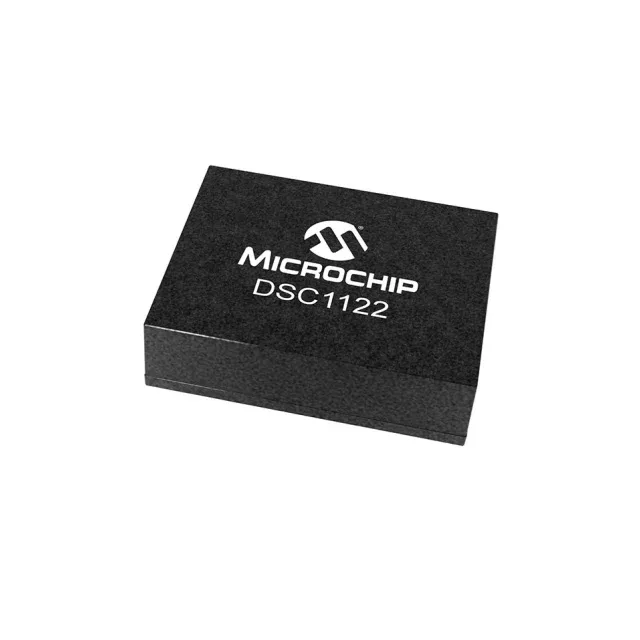
Automotive-grade MEMS reference clock at 8 MHz
The DSC6001JL3B-008.0000 is an 8 MHz MEMS-based XO from Microchip's DSC60XXB series, delivering a CMOS output with ±20 ppm frequency stability across -40 to +105 °C — the AEC-Q100 Grade 1 temperature band that suits under-hood ECUs, ADAS sensor modules, and body controllers. Supply voltage spans 1.8V to 3.3V, so the same BOM line works across 1.8V and 3.3V core-logic domains without a separate level translator — the Enable/Disable function lets the host processor gate the clock for sleep-mode power savings.
Why the ±20 ppm stability matters for CAN and sensor timing
A ±20 ppm window over the full -40 to +105 °C range keeps the bit-timing jitter within the margin for CAN FD and LIN buses — a 50 ppm oscillator would eat half the tolerance budget before the transceiver and connector losses are accounted for. The MEMS resonator is inherently more shock and vibration tolerant than a quartz crystal — the 4-VLGA package (2.5 mm × 2.0 mm) sits on the board with a low profile (0.89 mm seated height), which helps in confined automotive module cavities.
Package and layout fit for the 4-VLGA footprint
The 4-VLGA package is a 4-pin land-grid array with a 0.98-inch × 0.79-inch body — the centre pad is not connected, so a standard via-in-pad or dogbone fan-out works; the short traces to the MCU clock input keep the 8 MHz CMOS edge clean.