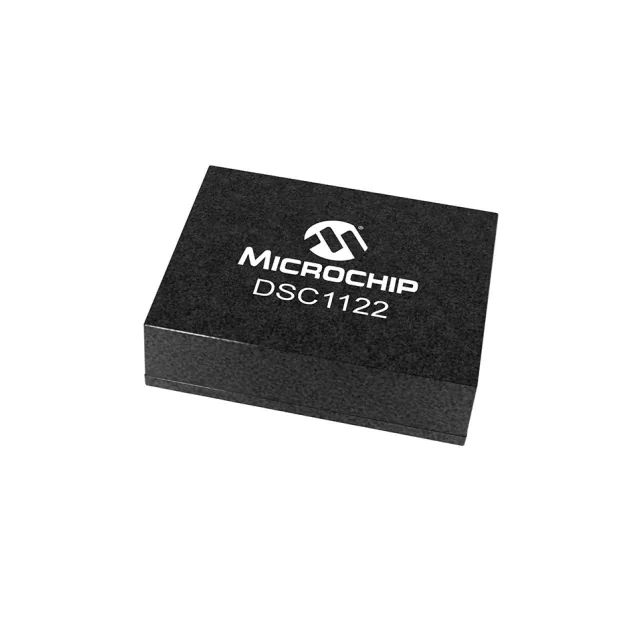
Microchip Technology DSC6001JA2B-025.0000T — Crystals & Oscillators

DSC6001JA2B-025.0000T MEMS XO 25 MHz AEC-Q100 - Microchip

MPNDSC6001JA2B-025.0000T
Active

Microchip Technology DSC60XXB series MEMS XO (Standard), 25 MHz CMOS output, 1.8V ~ 3.3V supply, ±25 ppm stability, -40°C ~ 125°C, AEC-Q100 qualified, 4-VLGA package

Sourced new & surplus through independent channelsAuthenticity-screened · ESD-safe packingListing updated Aug 2026

Specifications

DSC6001JA2B-025.0000T specifications
ParameterValue
TypeXO (Standard)
SeriesDSC60XXB
MountingSurface Mount
Voltage1.8V ~ 3.3V
Current - supply1.3mA (Typ)
Frequency25 MHz
Frequency stability±25ppm
Operating temperature-40°C ~ 125°C
Size (Dimension)0.098\" L x 0.079\" W (2.50mm x 2.00mm)
Height - seated0.035\" (0.89mm)
OutputCMOS
PackageTape & Reel (TR)
RatingsAEC-Q100
FunctionEnable/Disable
Base resonatorMEMS
Case4-VLGA

Product details

MEMS oscillator for automotive clock trees

The DSC6001JA2B-025.0000T is a 25 MHz MEMS-based XO (Standard) from Microchip's DSC60XXB series, delivering a CMOS output across a 1.8V to 3.3V supply range. Rated for -40°C to 125°C and AEC-Q100 qualified, it fits directly into automotive Grade 1 applications — engine control units, transmission modules, and chassis-domain ECUs where quartz oscillators risk frequency shift under vibration. The MEMS resonator is inherently more shock- and vibration-tolerant than a quartz crystal, which can exhibit start-up frequency errors under mechanical stress — a known failure mode in automotive and industrial environments.

Supply voltage and frequency stability

Operating from 1.8V to 3.3V, the oscillator can be powered from a single 1.8V or 3.3V rail without a level translator — a single BOM line serves both voltage domains. Frequency stability is ±25 ppm over the full temperature range and lifetime — tight enough for CAN, LIN, and USB full-speed interfaces without requiring a higher-grade ±10 ppm part. Typical supply current is 1.3 mA, lower than many quartz-based equivalents — relevant for battery-backed or always-on modules where every microamp matters.

Enable/Disable and package footprint

The enable/disable function lets the system power down the oscillator when the clock is not needed — reduces idle current in multi-rail designs or sleep-mode ECUs. Housed in a 4-VLGA package measuring 2.50mm x 2.00mm with a seated height of 0.89mm, the footprint is smaller than a typical 4-pin SMD crystal can, saving board space in densely packed automotive modules.

Supplied by Microchip Technology in Tape & Reel (TR) for automated assembly. Quoted to order against the BOM quantity; availability confirmed at RFQ.

Frequently asked questions

Is the DSC6001JA2B-025.0000T AEC-Q100 qualified?

Yes, it carries AEC-Q100 ratings, which means it has passed automotive-grade qualification including temperature cycling, ESD sensitivity, and reliability stress tests. The -40°C to 125°C operating range covers the Grade 1 temperature envelope for under-hood and engine-bay deployment.

Does the DSC6001JA2B-025.0000T have an enable/disable function?

Yes, the oscillator includes an enable/disable function. When the enable pin is de-asserted, the output is tri-stated and the oscillator enters a low-power state, reducing idle current in sleep-mode or multi-rail designs.

How does the DSC6001JA2B-025.0000T compare to a quartz crystal oscillator?

The DSC6001JA2B-025.0000T uses a MEMS resonator instead of a quartz crystal. MEMS oscillators are inherently more shock- and vibration-tolerant than quartz, which can exhibit start-up frequency errors under mechanical stress. The MEMS part also draws lower supply current (1.3 mA typical,) and operates across a wider supply voltage range (1.8V to 3.3V,) without external load capacitors. For most automotive and industrial applications, the MEMS oscillator is a drop-in replacement that eliminates quartz-related failure modes.