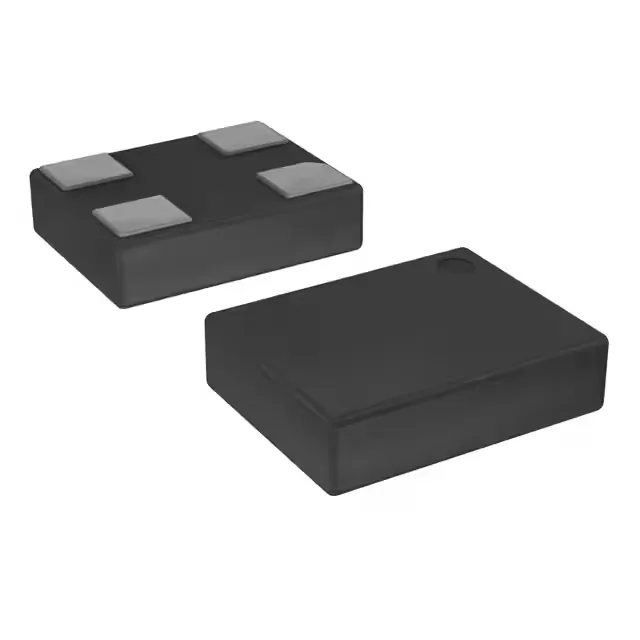
The DSC6001CI2A-080.0000 is a MEMS-based XO delivering 80 MHz CMOS output with ±25 ppm frequency stability across the full –40°C to +85°C industrial temperature range. The MEMS resonator eliminates the quartz-crystal startup margin and vibration sensitivity that often cause clock failures in high-shock environments like engine-bay ECUs or factory-floor drives. Supply voltage spans 1.71V to 3.63V, so the oscillator can run directly off a 1.8V or 3.3V rail without an intermediate LDO — one less component in the timing tree. Typical current draw is 1.3 mA, which keeps the thermal budget low even in dense boards. It is suited for infotainment clusters, ADAS camera modules, and body-control nodes where a crystal failure means a warranty return.
Obsolete – sourcing reality for the BOM line
If the BOM can accept a package change, the active DSC60XX variants with the same 3.2 mm × 2.5 mm footprint and 4-SMD, No Lead package may serve as a functional drop-in after verifying the Enable/Disable logic polarity and output drive strength. Cross-reference the DSC6001 datasheet against the current DSC60XX ordering guide before committing.
Enable/Disable function and board-level fit
When disabled, the oscillator core remains powered but the output buffer goes high-impedance — the downstream load sees no clock edge, which is useful for JTAG boundary-scan or low-power sleep states. The 4-SMD, No Lead package (3.20 mm × 2.50 mm, 0.90 mm seated height) is a standard MEMS oscillator footprint shared by many suppliers. The land pattern matches the common 4-pin oscillator layout; no via-in-pad or blind-via stack-up is required for a two-layer board.