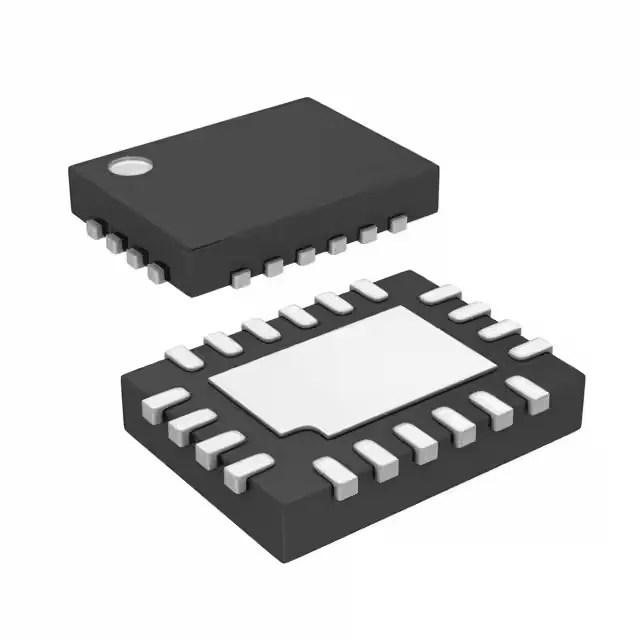
Microchip Technology DSC400-4111Q0112KI2T — Crystals & Oscillators

DSC400-4111Q0112KI2T MEMS XO – Quad Output, Industrial Temp

MPNDSC400-4111Q0112KI2T
Active

Microchip DSC400 series MEMS XO (Standard), quad-output: 25MHz, 25MHz, 25MHz, 100MHz/156.25MHz, HCSL/LVCMOS, ±25ppm stability, -40°C to 85°C, 20-VFQFN exposed pad, Enable/Disable function.

Sourced new & surplus through independent channelsAuthenticity-screened · ESD-safe packingListing updated Aug 2026

Specifications

DSC400-4111Q0112KI2T specifications
ParameterValue
TypeXO (Standard)
SeriesDSC400
Voltage2.25V ~ 3.6V
Frequency stability±25ppm
Frequency - output 125MHz
Frequency - output 225MHz
Frequency - output 325MHz
Frequency - output 4100MHz, 156.25MHz
Operating temperature-40°C~85°C
Height0.035\" (0.90mm)
Size (Dimension)0.197\" L x 0.126\" W (5.00mm x 3.20mm)
OutputHCSL, LVCMOS
PackageTape & Reel (TR)
FunctionEnable/Disable
Base resonatorMEMS
Case20-VFQFN Exposed Pad

Product details

MEMS oscillator with four independent clock outputs

Output frequencies are factory-configured: three lanes at 25MHz and a fourth lane selectable between 100MHz and 156.25MHz, supporting HCSL or LVCMOS logic levels. Frequency stability is rated at ±25ppm across the full -40°C to 85°C industrial temperature range, with a supply voltage tolerance of 2.25V to 3.6V.

Package, footprint, and board-level integration

Housed in a 20-VFQFN with exposed pad, measuring 5.00mm x 3.20mm with a seated height of 0.90mm — the thermal pad must be soldered to a PCB ground plane for rated heat dissipation and mechanical stability.

Frequently asked questions

What are the output options for DSC400-4111Q0112KI2T?

The device provides four outputs: three fixed at 25MHz and a fourth lane configurable to 100MHz or 156.25MHz. Output logic is selectable between HCSL and LVCMOS levels.

Is DSC400-4111Q0112KI2T a direct replacement for a standard quartz crystal oscillator?

No — this is a MEMS-based XO, not a quartz resonator. It generates multiple clock frequencies from a single silicon die, whereas a quartz oscillator typically provides one fixed frequency. The pinout and supply voltage (2.25V–3.6V) differ from common 3.3V or 5V quartz oscillators; verify compatibility with the target socket before substitution.