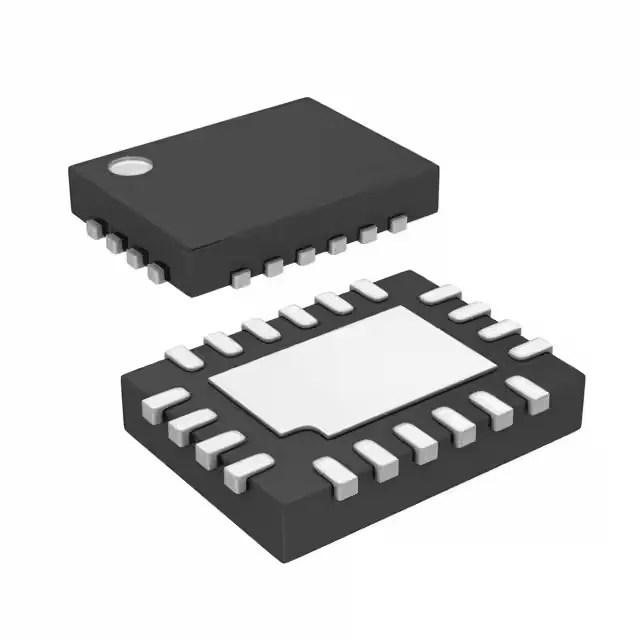
Microchip Technology DSC400-1111Q0090KE2T — Crystals & Oscillators

DSC400-1111Q0090KE2T MEMS XO — 4-Output LVCMOS Clock

MPNDSC400-1111Q0090KE2T
Active

Microchip DSC400 series, XO (Standard), quad-output MEMS oscillator, 10 MHz, 27 MHz, 148.5 MHz, 125 MHz, LVCMOS, 2.25 V ~ 3.6 V, ±25 ppm, -20°C ~ 70°C, 20-VFQFN Exposed Pad, Tape & Reel

Sourced new & surplus through independent channelsAuthenticity-screened · ESD-safe packingListing updated Aug 2026

Specifications

DSC400-1111Q0090KE2T specifications
ParameterValue
TypeXO (Standard)
SeriesDSC400
Voltage2.25V ~ 3.6V
Frequency stability±25ppm
Frequency - output 110MHz
Frequency - output 227MHz
Frequency - output 3148.5MHz
Frequency - output 4125MHz
Operating temperature-20°C~70°C
Height0.035\" (0.90mm)
Size (Dimension)0.197\" L x 0.126\" W (5.00mm x 3.20mm)
OutputLVCMOS
PackageTape & Reel (TR)
FunctionEnable/Disable
Base resonatorMEMS
Case20-VFQFN Exposed Pad

Product details

Quad-output MEMS clock in a single 5×3.2 mm QFN

The DSC400-1111Q0090KE2T packages four independent LVCMOS clock outputs — 10 MHz, 27 MHz, 148.5 MHz, and 125 MHz — from a single MEMS resonator in a 20-pin QFN with exposed pad. Frequency stability is ±25 ppm across the -20°C to +70°C commercial temperature range — tight enough for 10/100 Ethernet reference clocks and common video pixel rates without the cost of a TCXO.

The 2.25 V to 3.6 V supply range means this oscillator runs directly off a 2.5 V or 3.3 V rail with no external LDO. A board that mixes both voltage domains can use the same DSC400 order code across both sections, simplifying procurement and qualification.

Active production — no end-of-life urgency

Microchip lists the DSC400-1111Q0090KE2T as Active. The MEMS resonator construction avoids the lead-time variability associated with quartz-based oscillators, making this a stable choice for current designs.

Enable/Disable function and package notes

The 20-VFQFN with exposed pad demands a thermal via array under the paddle for heat sinking; the 0.90 mm height fits standard 1.6 mm PCB stack-ups.

Frequently asked questions

What is the DSC400-1111Q0090KE2T's frequency stability and what does it mean for my timing budget?

The ±25 ppm stability is specified over the -20°C to +70°C range. For a 125 MHz output, ±25 ppm equals ±3125 Hz of absolute frequency error — well within the capture range of a standard Ethernet PHY or FPGA PLL. The MEMS resonator also exhibits lower g-sensitivity than a quartz crystal, which matters in systems with fan vibration or mechanical shock.

Is the DSC400-1111Q0090KE2T compatible with a 2.5 V supply?

Yes. The supply voltage range is 2.25 V to 3.6 V, so a 2.5 V rail is well within the operating window. The LVCMOS output levels track the supply voltage — at 2.5 V the output high is approximately 2.5 V, which is compatible with 2.5 V logic families.

What are the four output frequencies and their typical applications?

Output 1: 10 MHz (common reference for Ethernet PHY or MCU). Output 2: 27 MHz (standard pixel clock for 480p/576p video encoders). Output 3: 148.5 MHz (common for 1080p HDMI or SDI video clocks). Output 4: 125 MHz (standard for Gigabit Ethernet MAC/PHY reference). The quad-output architecture lets a single oscillator feed multiple clock domains on a mixed-signal board.