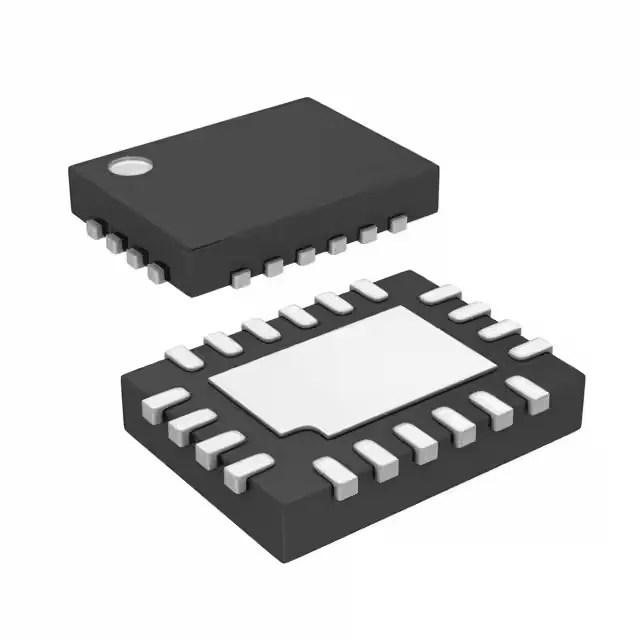
Microchip Technology DSC400-0101Q0115KI1T — Crystals & Oscillators

DSC400-0101Q0115KI1T MEMS XO – Dual Output LVCMOS, Active

MPNDSC400-0101Q0115KI1T
Active

Microchip Technology DSC400-0101Q0115KI1T, XO (Standard) series DSC400, MEMS resonator, LVCMOS dual outputs 12 MHz and 3.072 MHz, ±50 ppm stability, 2.25 V ~ 3.6 V supply, -40°C ~ +85°C, 20-VFQFN exposed pad, tape and reel.

Sourced new & surplus through independent channelsAuthenticity-screened · ESD-safe packingListing updated Aug 2026

Specifications

DSC400-0101Q0115KI1T specifications
ParameterValue
TypeXO (Standard)
SeriesDSC400
Voltage2.25V ~ 3.6V
Frequency stability±50ppm
Frequency - output 112MHz
Frequency - output 23.072MHz
Operating temperature-40°C~85°C
Height0.035\" (0.90mm)
Size (Dimension)0.197\" L x 0.126\" W (5.00mm x 3.20mm)
OutputLVCMOS
PackageTape & Reel (TR)
FunctionEnable/Disable
Base resonatorMEMS
Case20-VFQFN Exposed Pad

Product details

MEMS clock source with two fixed frequencies

The DSC400-0101Q0115KI1T: This is a MEMS-based XO that puts out two LVCMOS clocks: 12 MHz on output 1 and 3.072 MHz on output 2. The MEMS resonator means no quartz blank, no external load capacitors, and no crystal start-up time — it's powered up and oscillating within microseconds of the enable pin going high. Supply voltage spans 2.25 V to 3.6 V, so it runs from a 2.5 V or 3.3 V rail without a separate LDO.

Industrial temperature and ±50 ppm stability

Frequently asked questions

Can the DSC400-0101Q0115KI1T replace a typical 12 MHz crystal oscillator?

Yes, if the board expects a 12 MHz LVCMOS clock input. Unlike a quartz crystal, this MEMS XO does not require external load capacitors — it generates a full-swing LVCMOS output directly. The second output (3.072 MHz) is a bonus clock that can drive a separate peripheral or a UART baud-rate generator.

Does the DSC400-0101Q0115KI1T require external load capacitors?

No. Because the resonator is a MEMS structure sealed inside the package, the output is already a rail-to-rail LVCMOS signal. No external load caps, no feedback resistor — just connect the supply and the enable pin.

What is the frequency stability of this oscillator?

±50 ppm over the full -40°C to +85°C range and supply voltage variation. That stability class suits most Ethernet PHYs, MCU clock inputs, and USB interfaces without needing a separate temperature-compensation circuit.