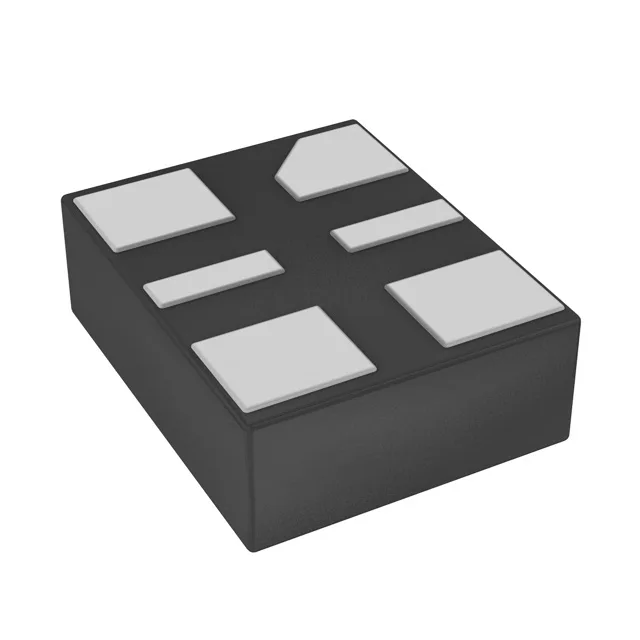
Microchip Technology DSC2311KI2-R0061T — Crystals & Oscillators

DSC2311KI2-R0061T MEMS XO – 25MHz & 100MHz CMOS, ±25ppm

MPNDSC2311KI2-R0061T
Active

Microchip DSC2311KI2-R0061T, XO (Standard) MEMS oscillator, 25 MHz + 100 MHz CMOS outputs, ±25 ppm stability, 2.25 V–3.6 V supply, -40°C to 85°C, 6-VDFN package

Sourced new & surplus through independent channelsAuthenticity-screened · ESD-safe packingListing updated Aug 2026

Specifications

DSC2311KI2-R0061T specifications
ParameterValue
TypeXO (Standard)
SeriesDSC2311
Voltage2.25V ~ 3.6V
Current - supply (Disable)23 mA
Frequency stability±25ppm
Frequency - output 125MHz
Frequency - output 2100MHz
Operating temperature-40°C~85°C
Height0.035\" (0.90mm)
Size (Dimension)0.098\" L x 0.079\" W (2.50mm x 2.00mm)
OutputCMOS
PackageTape & Reel (TR)
FunctionEnable/Disable
Base resonatorMEMS
Case6-VDFN

Product details

The DSC2311KI2-R0061T is a standard XO (Standard) based on a MEMS resonator, delivering two independent CMOS clock outputs: 25 MHz on output 1 and 100 MHz on output 2. This dual-frequency part replaces two single oscillators on the board, saving footprint and BOM line count. Housed in a 6-VDFN package measuring 2.50 mm × 2.00 mm with a 0.90 mm seated height, it fits dense PCB layouts where vertical clearance is tight.

For a 100 MHz clock, ±25 ppm translates to ±2.5 kHz of maximum frequency deviation — tight enough to keep a gigabit Ethernet PHY or a USB 2.0 controller within their PLL capture range without re-centering. The supply voltage spans 2.25 V to 3.6 V, so the same oscillator can be fed from a 2.5 V or 3.3 V rail without a separate regulator.

Active production – no end-of-life watch needed

Microchip lists the DSC2311KI2-R0061T as Active. The base product number DSC2311 covers a family of dual-output MEMS XOs; this specific variant is the 25 MHz + 100 MHz, ±25 ppm, -40°C to 85°C grade.

Frequently asked questions

What is the DSC2311KI2-R0061T used for?

It is a dual-output MEMS oscillator providing a 25 MHz and a 100 MHz CMOS clock from a single 6-VDFN package. Typical applications include clocking FPGAs, SoCs, Ethernet PHYs, and USB controllers where two independent frequencies are needed and board space is limited.