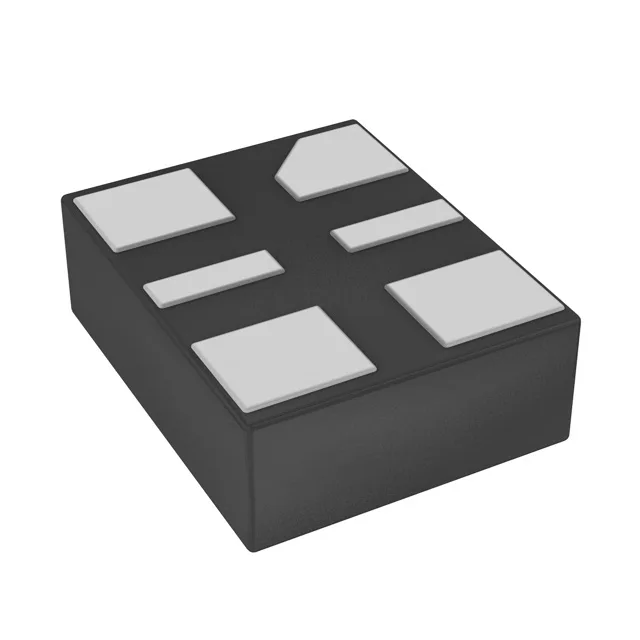
Microchip Technology DSC2311KI2-R0055T — Crystals & Oscillators

DSC2311KI2-R0055T MEMS Oscillator – 16 MHz & 27.034483 MHz

MPNDSC2311KI2-R0055T
Active

Microchip DSC2311KI2-R0055T, XO (Standard), dual-output MEMS oscillator: 16 MHz and 27.034483 MHz, CMOS, ±25 ppm, 2.25-3.6V, -40 to +85°C, 6-VDFN package.

Independent supplier — new & surplus stockAuthenticity-screened · ESD-safe packingListing updated Aug 2026

Specifications

DSC2311KI2-R0055T specifications
ParameterValue
TypeXO (Standard)
SeriesDSC2311
Supply voltage2.25V ~ 3.6V
Current - supply (Disable)23 mA
Frequency stability±25ppm
Frequency - output 116MHz
Frequency - output 227.034483MHz
Operating temperature-40°C~85°C
Height0.035\" (0.90mm)
Size (Dimension)0.098\" L x 0.079\" W (2.50mm x 2.00mm)
OutputCMOS
PackageTape & Reel (TR)
FunctionEnable/Disable
Base resonatorMEMS
Case6-VDFN

Product details

Two clock rails from one MEMS die

The DSC2311KI2-R0055T is a dual-output XO (Standard) from Microchip's DSC2311 series, delivering 16 MHz on output 1 and 27.034483 MHz on output 2 from a single MEMS resonator. This eliminates the need for two separate crystal oscillators on the board, saving one component line and the associated PCB area. The CMOS output levels track the supply rail, which spans 2.25V to 3.6V — covering 2.5V and 3.3V logic without an external level translator.

The 6-VDFN package measures 2.50 mm x 2.00 mm with a 0.90 mm height — a compact footprint that fits dense PCB layouts.

Frequently asked questions

What are the two output frequencies of the DSC2311KI2-R0055T?

Output 1 is 16 MHz and output 2 is 27.034483 MHz, both fixed from the factory. There is no programmable option — the frequencies are set at manufacture per the R0055T ordering code.

Can the DSC2311KI2-R0055T replace a standard quartz oscillator on my board?

Yes, in most cases. The MEMS-based DSC2311KI2-R0055T is a drop-in replacement for a quartz XO in the same 6-VDFN footprint, with the same CMOS output and 2.5V/3.3V supply compatibility. The MEMS resonator offers better shock tolerance and faster startup than quartz, but the electrical interface is identical — no board spin required.