MEMS resonator — no quartz, no cold-start drift
That means no frequency drift from crystal aging or cold-start warm-up — the oscillator hits its ±25 ppm stability immediately at power-up, which matters for a SerDes reference clock that must lock before the link trains. It is a standard XO with LVDS output, so it drives a differential clock pair directly — no external level translator needed when feeding an FPGA or a gigabit transceiver.
Dual output — one can replaces two cans
This part generates two independent output frequencies from the same MEMS die. The output 1 and output 2 lists both include 100 MHz, 125 MHz, 156.25 MHz, 312.5 MHz, 312.898 MHz, and 439.597 MHz — common Ethernet, PCIe, and SerDes rates. One 14-VFQFN package replaces two discrete oscillators, saving board area and reducing BOM line count.
Industrial temperature range — field-fit decision
The MEMS construction handles vibration better than quartz — a practical advantage in motor-drive or automotive environments.
Supply range and current — BOM-fit note
The 2.25 V to 3.6 V supply range covers 2.5 V and 3.3 V rails without a separate regulator. Typical current is 38 mA — low enough for a shared 3.3 V rail on a multi-oscillator board, but check the disable current of 23 mA if the part is powered but gated off.
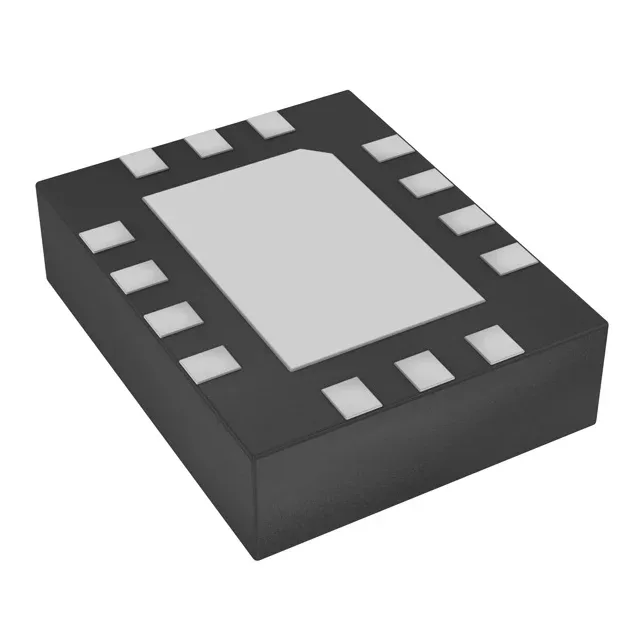
Package — 14-VFQFN with exposed pad
The 14-VFQFN exposed-pad package measures 3.20 mm x 2.50 mm with a 0.90 mm height.