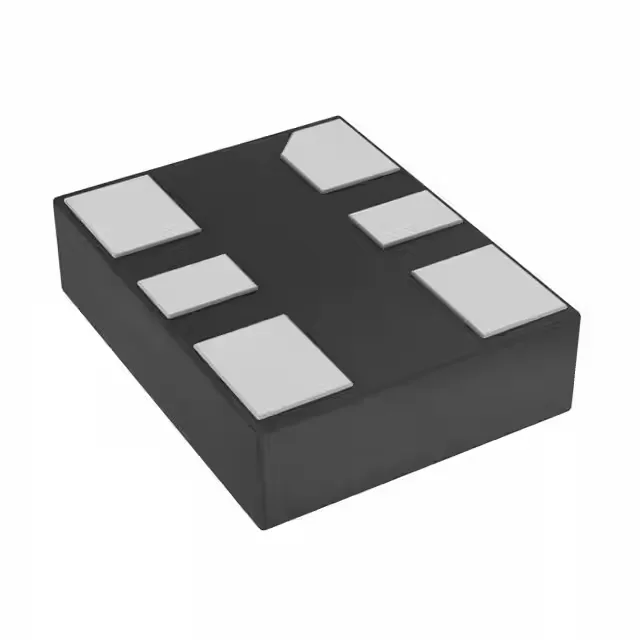
Microchip Technology DSC1124CL2-100.0000T — Crystals & Oscillators

DSC1124CL2-100.0000T – Microchip MEMS XO, 100 MHz HCSL

MPNDSC1124CL2-100.0000T
Active

Microchip DSC1124 series MEMS XO (Standard), 100 MHz, HCSL output, ±25 ppm stability, 2.25V–3.6V supply, -40°C to 105°C, 6-SMD package.

Independent supplier — new & surplus stockAuthenticity-screened · ESD-safe packingListing updated Aug 2026

Specifications

DSC1124CL2-100.0000T specifications
ParameterValue
TypeXO (Standard)
SeriesDSC1124
MountingSurface Mount
Supply voltage2.25V ~ 3.6V
Current - supply42mA
Current - supply (Disable)22mA
Frequency100 MHz
Frequency stability±25ppm
Operating temperature-40°C~105°C
Size (Dimension)0.126\" L x 0.098\" W (3.20mm x 2.50mm)
Height - seated0.035\" (0.90mm)
OutputHCSL
PackageTape & Reel (TR)
FunctionEnable/Disable
Base resonatorMEMS
Case6-SMD, No Lead

Product details

MEMS oscillator at 100 MHz with HCSL output

Supply voltage spans 2.25 V to 3.6 V, so the same part works on 2.5 V and 3.3 V rails without a separate level translator. Maximum supply current is 42 mA when active, dropping to 22 mA when disabled.

Industrial temperature range and stability

Frequency stability is ±25 ppm across the full range — tight enough for 1000BASE-T Ethernet and most PCIe Gen 1/2/3 reference clock jitter budgets. The 6-SMD, no-lead package measures 3.20 mm x 2.50 mm with a seated height of 0.90 mm — standard 2.5 x 3.2 mm footprint, compatible with common oscillator land patterns.

Microchip lists the DSC1124CL2-100.0000T as Active. No PCN or EOL notice has been issued for this series.

Frequently asked questions

What is the output type of the DSC1124CL2-100.0000T?

HCSL (High-Speed Current Steering Logic) — a differential output with a typical swing of 0.7 V peak-to-peak, designed to drive 50-ohm terminated lines. Commonly used as a PCIe reference clock.

Does the DSC1124CL2-100.0000T support enable/disable?

Yes. The function is Enable/Disable. When disabled, the output goes into a high-impedance state and the supply current drops to 22 mA max. There is no standby mode — the oscillator core remains powered.

What are the advantages of MEMS oscillators over quartz for this part?

The MEMS resonator is inherently more resistant to shock and vibration than a quartz crystal, and the oscillator typically has shorter lead times because the MEMS die is fabricated in a standard CMOS process. The frequency stability (±25 ppm) is comparable to a basic quartz XO.