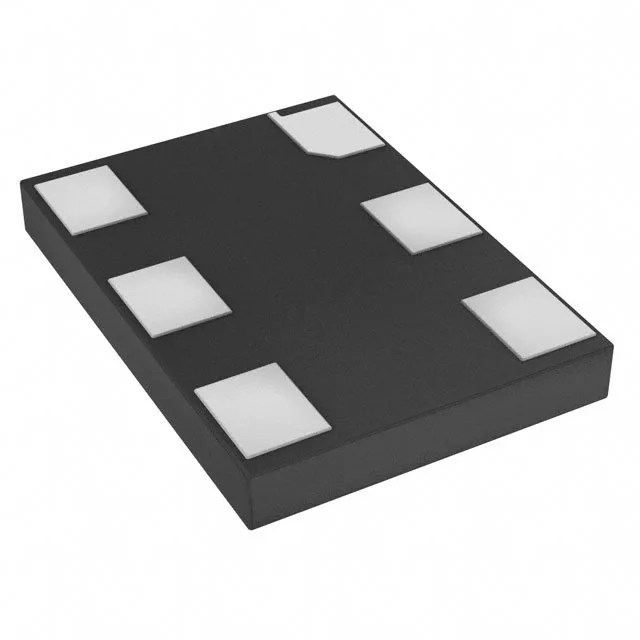
Microchip Technology DSC1123NL2-100.0000 — Crystals & Oscillators

DSC1123NL2-100.0000 MEMS XO 100 MHz LVDS

MPNDSC1123NL2-100.0000
Active

Microchip DSC1123 series, XO (Standard), 100 MHz, LVDS output, ±25 ppm stability, -40°C to 105°C, 6-SMD no-lead package.

$3.0500Ref. price · indicative, final on quote
Independent supplier — new & surplus stockAuthenticity-screened · ESD-safe packingListing updated Aug 2026

Specifications

DSC1123NL2-100.0000 specifications
ParameterValue
TypeXO (Standard)
SeriesDSC1123
MountingSurface Mount
Supply voltage2.25V ~ 3.63V
Current - supply22mA
Frequency100 MHz
Frequency stability±25ppm
Operating temperature-40°C~105°C
Size (Dimension)0.276\" L x 0.197\" W (7.00mm x 5.00mm)
Height - seated0.035\" (0.90mm)
OutputLVDS
PackageTube
FunctionEnable/Disable
Base resonatorMEMS
Case6-SMD, No Lead

Product details

MEMS oscillator at 100 MHz with LVDS

The supply voltage spans 2.25V to 3.63V, covering 2.5V and 3.3V rails with margin; the 22 mA max supply current is the total draw including the LVDS output stage, so the regulator sizing is straightforward.

The 6-SMD no-lead package measures 7.00mm x 5.00mm with a seated height of 0.90mm — a common footprint shared by many 7x5 mm oscillators, simplifying a drop-in swap if the BOM already uses that land pattern.

Microchip's DSC1123 series is the base product number; the suffix NL2-100.0000 encodes the 100 MHz frequency, LVDS output, and ±25 ppm stability.

Frequently asked questions

Is the DSC1123NL2-100.0000 a direct replacement for my existing quartz oscillator?

If your existing oscillator is a 100 MHz LVDS device in a 7.0x5.0 mm 6-SMD package with an enable/disable pin, the DSC1123NL2-100.0000 is a functional and footprint-compatible replacement. The MEMS resonator eliminates the quartz start-up time and is less sensitive to vibration, but the output type (LVDS) and supply range (2.25V–3.63V) must match your receiver input thresholds.

Does the DSC1123NL2-100.0000 have an enable/disable function?

Yes, the Enable/Disable function allows the output to be tri-stated while the supply remains active. The pin is typically pulled high internally; driving it low disables the output.