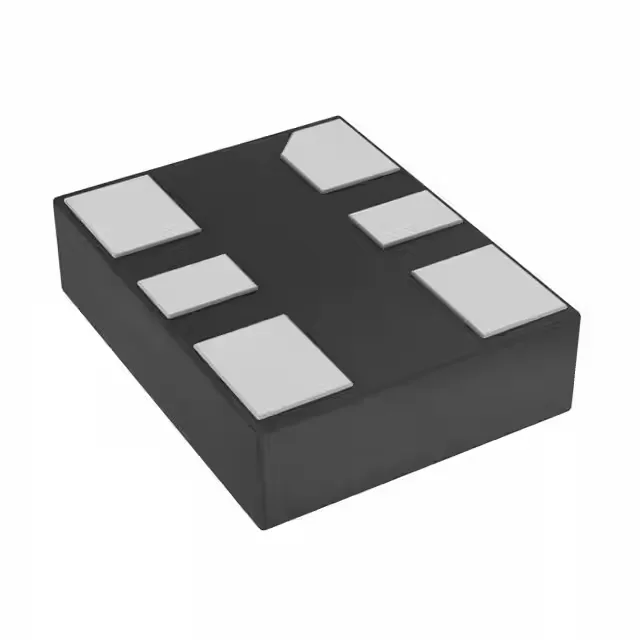
Microchip Technology DSC1123CI2-333.3300T — Crystals & Oscillators

DSC1123CI2-333.3300T Microchip MEMS XO, 333.33 MHz LVDS

MPNDSC1123CI2-333.3300T
Active

Microchip DSC1123 series MEMS XO, 333.33 MHz LVDS output, ±25 ppm stability, 2.25 V to 3.63 V supply, enable/disable function, -40°C to 85°C industrial temperature range, 6-SMD no-lead package.

$4.2900Ref. price · indicative, final on quote
Sourced new & surplus through independent channelsAuthenticity-screened · ESD-safe packingListing updated Aug 2026

Specifications

DSC1123CI2-333.3300T specifications
ParameterValue
TypeXO (Standard)
SeriesDSC1123
MountingSurface Mount
Voltage2.25V ~ 3.63V
Current - supply32mA
Current - supply (Disable)22mA
Frequency333.33 MHz
Frequency stability±25ppm
Operating temperature-40°C~85°C
Size (Dimension)0.126\" L x 0.098\" W (3.20mm x 2.50mm)
Height - seated0.035\" (0.90mm)
OutputLVDS
PackageTape & Reel (TR)
FunctionEnable/Disable
Base resonatorMEMS
Case6-SMD, No Lead

Product details

333.33 MHz LVDS clock for high-speed interfaces

The DSC1123CI2-333.3300T delivers a 333.33 MHz LVDS output from a MEMS resonator — a frequency that directly clocks 10 GbE PHYs, FPGA transceiver reference inputs, or SERDES framers without an external PLL.

MEMS vs quartz — what the resonator means for the BOM

The DSC1123CI2-333.3300T draws 32 mA max from a 2.25 V to 3.63 V supply, and the enable/disable pin pulls the output to high-impedance while dropping supply current to 22 mA — useful for power-gating the clock tree in a system that sleeps between bursts. MEMS oscillators typically survive 50 000 g shock and 70 g vibration, a step up from quartz for equipment that ships or operates in high-vibration environments.

Package and board layout notes

The 6-SMD no-lead package measures 3.20 mm x 2.50 mm with a seated height of 0.90 mm max. The enable pin is active-high; leave it pulled high through a 10 kΩ resistor if the function is unused.

Frequently asked questions

Is the DSC1123CI2-333.3300T a direct replacement for a standard quartz oscillator?

Functionally yes — it is a drop-in XO replacement in the same 6-SMD footprint. The MEMS resonator gives faster start-up (typically under 5 ms vs 10 ms for quartz) and better shock/vibration tolerance. The LVDS output is differential, so the receiving device must have an LVDS input — it will not drive a single-ended CMOS load without a level translator.