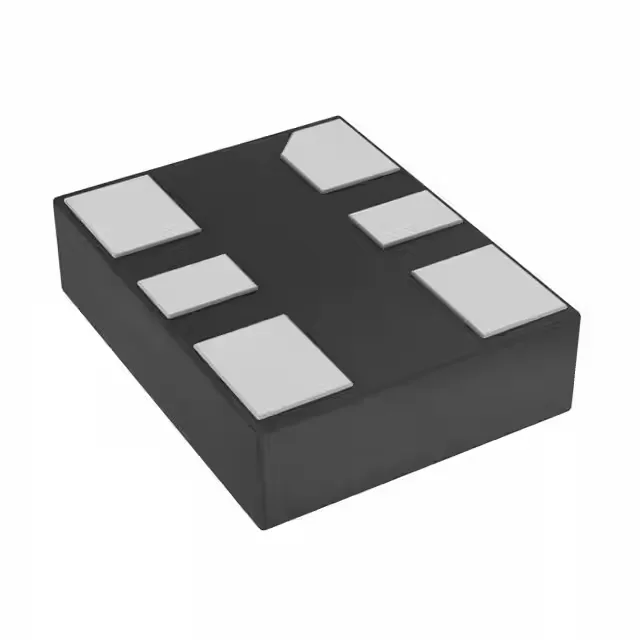
Microchip Technology DSC1123CI2-100.0000T — Crystals & Oscillators

DSC1123CI2-100.0000T 100 MHz LVDS MEMS Oscillator

MPNDSC1123CI2-100.0000T
Active

Microchip Technology DSC1123CI2-100.0000T, XO (Standard), 100 MHz LVDS output, MEMS resonator, ±25 ppm stability, AEC-Q100 qualified, 2.25V-3.63V supply, 6-SMD package.

$2.9500Ref. price · indicative, final on quote
Independent supplier — new & surplus stockAuthenticity-screened · ESD-safe packingListing updated Aug 2026

Specifications

DSC1123CI2-100.0000T specifications
ParameterValue
TypeXO (Standard)
SeriesDSC1123
MountingSurface Mount
Supply voltage2.25V ~ 3.63V
Current - supply32mA
Current - supply (Disable)22mA
Frequency100 MHz
Frequency stability±25ppm
Operating temperature-40°C~85°C
Size (Dimension)0.126\" L x 0.098\" W (3.20mm x 2.50mm)
Height - seated0.035\" (0.90mm)
OutputLVDS
PackageTape & Reel (TR); Cut Tape (CT)
RatingsAEC-Q100
FunctionEnable/Disable
Base resonatorMEMS
Case6-SMD, No Lead

Product details

That puts it in the cabin and under-hood domain — a gearbox controller or a LiDAR processing board that sees 85°C ambient still has margin.

Supply voltage tolerance and current draw

The supply range spans 2.25V to 3.63V — a single 3.3V or 2.5V rail is fine, and the 1.38V window covers a 3.3V rail that droops under load without losing lock.

Housed in a 6-SMD, No Lead package measuring 3.20 mm x 2.50 mm with a seated height of 0.90 mm. That is a standard 3.2 x 2.5 mm oscillator footprint — same land pattern as many quartz oscillators, so a board already laid out for a 3.2x2.5 mm can usually take this MEMS part without a layout spin. Surface-mount only; no through-hole option.

Listed as Active by Microchip Technology — no EOL or NRND flags.

Frequently asked questions

What is the output type of DSC1123CI2-100.0000T?

The output is LVDS (Low-Voltage Differential Signaling) — a differential pair that drives 100-ohm terminated lines cleanly at 100 MHz.

Can I replace a crystal oscillator with DSC1123CI2-100.0000T?

Yes, if the board uses a standard 3.2 x 2.5 mm oscillator footprint and expects a 100 MHz LVDS input. The MEMS resonator is more shock-tolerant than quartz, but confirm the supply voltage and enable polarity match the existing circuit.