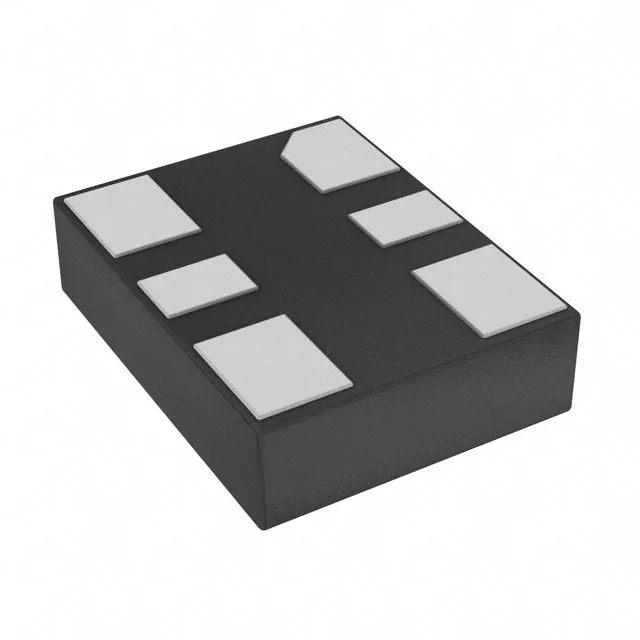
Microchip Technology DSC1123CI2-050.0000 — Crystals & Oscillators

DSC1123CI2-050.0000 MEMS XO, LVDS, AEC-Q100, 50 MHz

MPNDSC1123CI2-050.0000
Active

Microchip DSC1123CI2-050.0000, DSC1123 series, XO (Standard), MEMS-based, 50 MHz, LVDS output, Enable/Disable function, AEC-Q100 qualified, Surface Mount, 6-SMD No Lead package, 2.25V to 3.63V supply.

Sourced new & surplus through independent channelsAuthenticity-screened · ESD-safe packingListing updated Aug 2026

Specifications

DSC1123CI2-050.0000 specifications
ParameterValue
TypeXO (Standard)
SeriesDSC1123
MountingSurface Mount
Voltage2.25V ~ 3.63V
Current - supply32mA
Current - supply (Disable)22mA
Frequency50 MHz
Frequency stability±25ppm
Operating temperature-40°C ~ 85°C
Size (Dimension)0.126\" L x 0.098\" W (3.20mm x 2.50mm)
Height - seated0.035\" (0.90mm)
OutputLVDS
PackageTube
RatingsAEC-Q100
FunctionEnable/Disable
Base resonatorMEMS
Case6-SMD, No Lead

Product details

50 MHz MEMS XO with LVDS and AEC-Q100 qualification

The DSC1123CI2-050.0000 is a 50 MHz MEMS-based oscillator from Microchip's DSC1123 series, delivering an LVDS output — a differential signal pair that rejects common-mode noise on long board traces or cables, making it a clean clock source for high-speed serial interfaces like Ethernet PHYs or FPGAs that expect LVDS inputs.

Supply flexibility and enable/disable control

The supply range spans 2.25V to 3.63V, so it runs directly off a 2.5V or 3.3V rail without a separate regulator. At 3.3V, maximum supply current is 32 mA, and the disable function drops it to 22 mA — useful for power-gating a clock tree during system sleep modes. The Enable/Disable pin is a standard tri-state control: pulling it low puts the output into high-impedance, not just stopping oscillation, so multiple oscillators can share a bus without contention.

Frequently asked questions

What is the output type of DSC1123CI2-050.0000?

LVDS (Low-Voltage Differential Signaling) — a differential output that typically drives 100-ohm terminated lines. It is not compatible with single-ended CMOS inputs without an LVDS receiver or AC-coupling and termination.