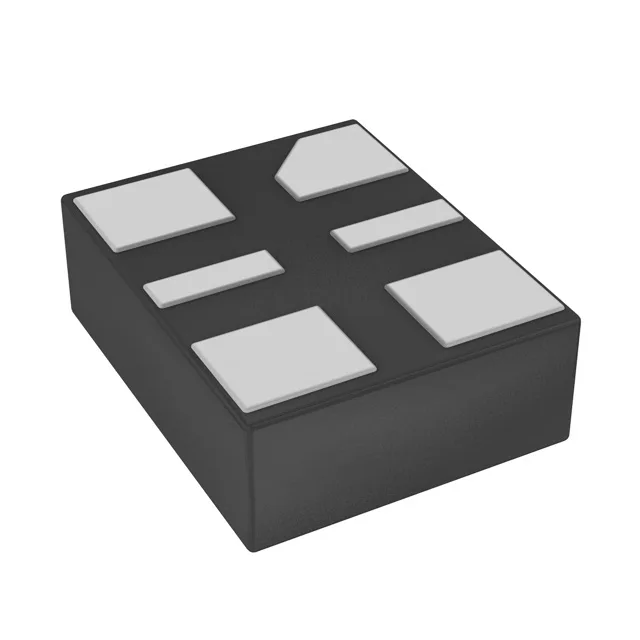
Microchip Technology DSC1122DI2-100.0000T — Crystals & Oscillators

DSC1122DI2-100.0000T – 100 MHz LVPECL MEMS Oscillator

MPNDSC1122DI2-100.0000T
Active

Microchip DSC1122DI2-100.0000T, DSC1122 series, XO (Standard) MEMS oscillator, 100 MHz LVPECL output, ±25 ppm stability, 2.25V–3.6V supply, -40°C to 85°C, 6-SMD no lead, Tape & Reel

Sourced new & surplus through independent channelsAuthenticity-screened · ESD-safe packingListing updated Aug 2026

Specifications

DSC1122DI2-100.0000T specifications
ParameterValue
TypeXO (Standard)
SeriesDSC1122
MountingSurface Mount
Voltage2.25V ~ 3.6V
Current - supply58mA
Current - supply (Disable)22mA
Frequency100 MHz
Frequency stability±25ppm
Operating temperature-40°C~85°C
Size (Dimension)0.098\" L x 0.079\" W (2.50mm x 2.00mm)
Height - seated0.035\" (0.90mm)
OutputLVPECL
PackageTape & Reel (TR)
FunctionEnable/Disable
Base resonatorMEMS
Case6-SMD, No Lead

Product details

100 MHz LVPECL MEMS oscillator for industrial clock trees

The LVPECL signalling delivers the fast edge rates and low jitter needed for high-speed FPGA reference clocks, SERDES PLLs, and 10G Ethernet PHY timing, where a single-ended CMOS output would degrade signal integrity over a long trace.

Supply flexibility and frequency stability

The 2.25V to 3.6V supply range lets the oscillator run directly from a 2.5V or 3.3V rail without an intermediate LDO — one less regulator in the BOM for a tight power budget.

Package and footprint for high-speed layout

Housed in a 6-SMD, No Lead package measuring 2.50 mm x 2.00 mm with a seated height of 0.90 mm. The small footprint and LVPECL output require careful impedance-controlled routing — the differential pair should be 50-ohm single-ended, 100-ohm differential, with the trace length matched to within 5 mm to minimise skew.

Frequently asked questions

Is DSC1122DI2-100.0000T compatible with a 3.3V supply?

Yes. The supply voltage range is 2.25V to 3.6V, so a 3.3V rail is within spec. No external regulator is needed.

How does DSC1122DI2-100.0000T compare to a standard quartz oscillator?

The MEMS resonator is less sensitive to mechanical shock and vibration than a quartz crystal, and the ±25 ppm stability is comparable to a standard quartz XO. The LVPECL output is a key difference — most quartz oscillators in this footprint offer CMOS or LVDS, not LVPECL. If your design requires LVPECL, this is a direct fit; if you need CMOS, look at the DSC1121 series.