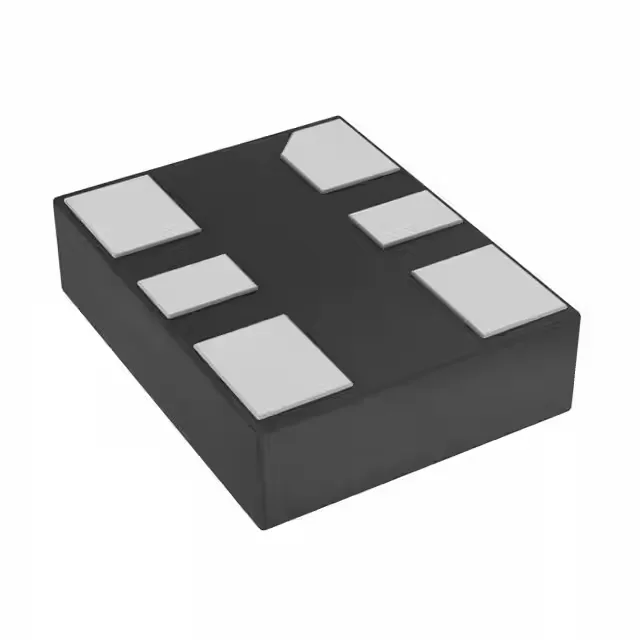
Microchip Technology DSC1122CI5-200.0000T — Crystals & Oscillators

DSC1122CI5-200.0000T MEMS Oscillator 200 MHz LVPECL

MPNDSC1122CI5-200.0000T
Active

Microchip Technology DSC1122CI5-200.0000T, XO (Standard), 200 MHz, LVPECL output, MEMS base resonator, ±10 ppm stability, 6-SMD no-lead, -40°C to 85°C

$5.2500Ref. price · indicative, final on quote
Independent supplier — new & surplus stockAuthenticity-screened · ESD-safe packingListing updated Aug 2026

Specifications

DSC1122CI5-200.0000T specifications
ParameterValue
TypeXO (Standard)
SeriesDSC1122
MountingSurface Mount
Supply voltage2.25V ~ 3.6V
Current - supply58mA
Current - supply (Disable)22mA
Frequency200 MHz
Frequency stability±10ppm
Operating temperature-40°C~85°C
Size (Dimension)0.126\" L x 0.098\" W (3.20mm x 2.50mm)
Height - seated0.035\" (0.90mm)
OutputLVPECL
PackageTape & Reel (TR)
FunctionEnable/Disable
Base resonatorMEMS
Case6-SMD, No Lead

Product details

200 MHz LVPECL from a MEMS resonator — what it buys you

The LVPECL output swings rail-to-rail with a typical 800 mVpp differential swing, driving 50-Ω terminated lines directly — no external bias resistors needed. At 200 MHz the 58 mA max supply current is the thermal budget to check: in still air the 6-SMD package dissipates that with minimal rise, but in a 85 °C ambient the junction stays within the silicon rating.

Active production — sourcing and lifecycle

Microchip lists the DSC1122CI5-200.0000T as Active.

Frequently asked questions

Is the DSC1122CI5-200.0000T a drop-in replacement for a standard 200 MHz quartz oscillator?

Pin-compatible with the standard 6-SMD no-lead footprint (3.2 mm × 2.5 mm), but the output is LVPECL, not LVCMOS. A quartz oscillator with LVCMOS output will not drive LVPECL inputs directly — check the receiver's input type. The MEMS base also means faster start-up and better shock tolerance than quartz.

Can the DSC1122CI5-200.0000T run from a 3.3 V supply?

Yes. The supply range is 2.25 V to 3.6 V, so both 2.5 V and 3.3 V rails work. The LVPECL output swing scales with the supply but stays within the receiver's common-mode range as long as the termination matches the supply.