MEMS oscillator at 47.998 MHz — why the exact frequency matters
The DSC1122CI5-047.9980 is a MEMS-based XO (Standard) from Microchip's DSC1122 series, delivering a LVPECL output at 47.998 MHz. That frequency is not a standard multiple of a common crystal — it is likely a reference clock for a specific SERDES, Ethernet PHY, or FPGA transceiver that requires a precise non-standard rate. Using a quartz oscillator at this frequency would need a custom crystal, which adds lead time and cost; the MEMS approach avoids that entirely.
Supply voltage and output — matching the rail and the receiver
The supply voltage range spans 2.25V to 3.6V, so the oscillator runs directly from a 2.5V or 3.3V rail without an extra LDO. The LVPECL output is a differential signal that requires a 50-ohm termination to Vcc-2V at the receiver — a standard termination for high-speed clocks. If the downstream device expects LVDS or HCSL, a level translator or AC-coupling with bias resistors is needed; LVPECL is not directly compatible.
Industrial temperature grade and tight stability
Enable/Disable function and power savings
Package footprint and board layout
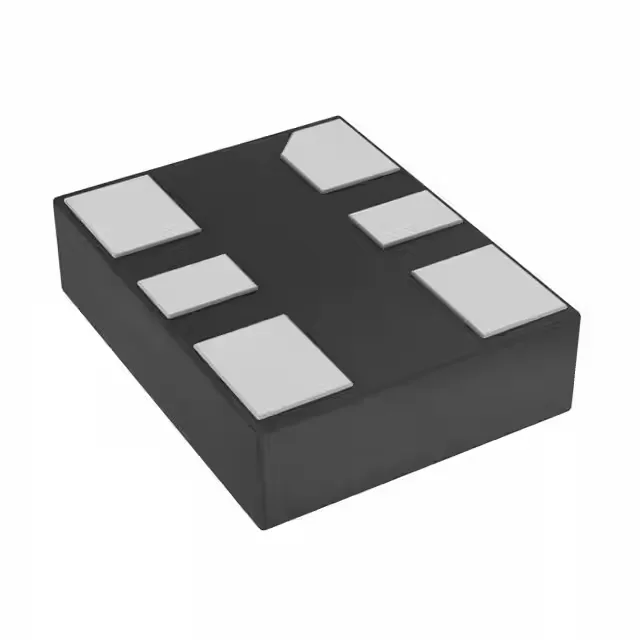
The 6-SMD, No Lead package measures 3.20mm x 2.50mm with a seated height of 0.90mm — a compact footprint that fits dense PCB layouts. The no-lead construction eliminates bent-pin issues during assembly and reflow. The pad layout follows the standard 6-pin MEMS oscillator land pattern; verify the pin 1 orientation for the enable function.