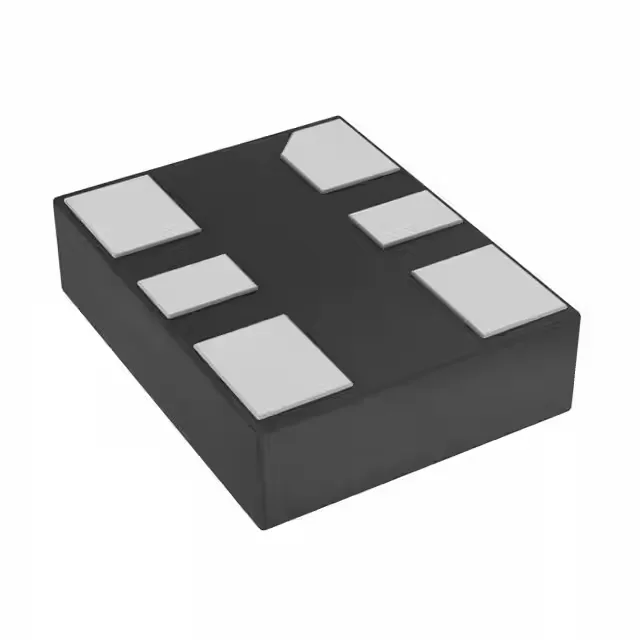
Microchip Technology DSC1122CI2-062.5000 — Crystals & Oscillators

DSC1122CI2-062.5000 Microchip MEMS XO, LVPECL, 62.5 MHz

MPNDSC1122CI2-062.5000
Active

Microchip Technology DSC1122CI2-062.5000, MEMS-based XO (Standard), LVPECL output, 62.5 MHz, ±25 ppm stability, -40°C to 85°C, 6-SMD No Lead package.

Independent supplier — new & surplus stockAuthenticity-screened · ESD-safe packingListing updated Aug 2026

Specifications

DSC1122CI2-062.5000 specifications
ParameterValue
TypeXO (Standard)
SeriesDSC1122
MountingSurface Mount
Supply voltage2.25V ~ 3.6V
Current - supply58mA
Current - supply (Disable)22mA
Frequency62.5 MHz
Frequency stability±25ppm
Operating temperature-40°C~85°C
Size (Dimension)0.126\" L x 0.098\" W (3.20mm x 2.50mm)
Height - seated0.035\" (0.90mm)
OutputLVPECL
PackageTube
FunctionEnable/Disable
Base resonatorMEMS
Case6-SMD, No Lead

Product details

MEMS oscillator with LVPECL output at 62.5 MHz

The supply voltage range is 2.25 V to 3.6 V, covering 2.5 V and 3.3 V rails without an external regulator — the internal LDO cleans the rail for the MEMS and PLL.

The 6-SMD No Lead package measures 3.20 mm x 2.50 mm with a seated height of 0.90 mm — a standard footprint that matches many 6-pin XO layouts from other suppliers. LVPECL output requires DC bias (typically Vcc - 1.3 V) and AC-coupled termination; the datasheet application circuit shows the recommended 50-ohm pull-up to Vcc - 2 V or a Thevenin equivalent.

Frequently asked questions

Is DSC1122CI2-062.5000 equivalent to other 62.5 MHz LVPECL oscillators?

Any 62.5 MHz LVPECL XO in a 6-SMD 3.2 x 2.5 mm package with a 2.25-3.6 V supply and Enable/Disable function is a functional equivalent. The MEMS resonator is the differentiator — quartz-based parts may have longer startup time and different vibration sensitivity.

Does DSC1122CI2-062.5000 require external load capacitors?

No. The LVPECL output is a differential signal with a defined DC bias and swing — it does not use the parallel-resonant load capacitors that a quartz crystal or CMOS oscillator would require. The termination is resistive (50 ohms to Vcc - 2 V or Thevenin equivalent), not capacitive.