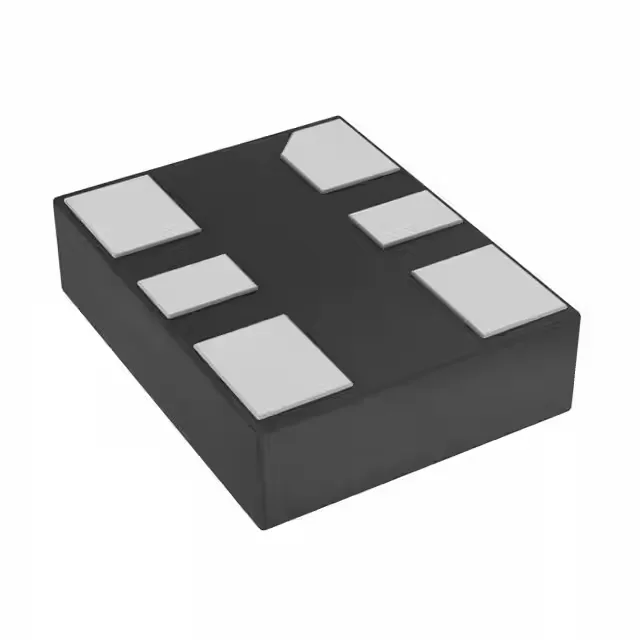
The DSC1122CI1-155.5200T is a MEMS-based XO (standard oscillator) from Microchip, delivering a 155.52 MHz LVPECL output with ±50 ppm frequency stability. That frequency is a standard telecom rate — 155.52 MHz is the line rate for OC-3/STM-1 optical transport and the reference for many 10/25 GbE SerDes PLLs. The LVPECL output provides a differential, low-jitter clock with typical sub-1 ps phase noise, which keeps the signal eye open across backplane traces and high-speed connectors. For a board that sees vibration in a fan tray or a portable instrument, the MEMS construction is a reliability upgrade — no crystal to crack or detune.
The supply voltage spans 2.25 V to 3.6 V, covering both 2.5 V and 3.3 V rails without an external regulator. At 3.3 V the oscillator draws 58 mA max (supply current), which is typical for a 155 MHz LVPECL driver — the differential output pair is always on, so the current is load-independent. It suits outdoor telecom cabinets, base stations, and industrial controllers that see seasonal thermal swings. The ±50 ppm stability holds across that range — no frequency drift compensation needed in the downstream PLL.
Package and footprint – 6-SMD no-lead, 3.2 × 2.5 mm
The 6-SMD no-lead package measures 3.20 mm × 2.50 mm with a seated height of 0.90 mm. That is a compact footprint for a high-frequency oscillator — it fits under a mezzanine card or next to a SerDes transceiver without crowding the routing channel. The no-lead (LCC) style has flat contacts on the bottom; rework is straightforward with a hot-air station if the pad layout has a thermal relief to the ground plane.