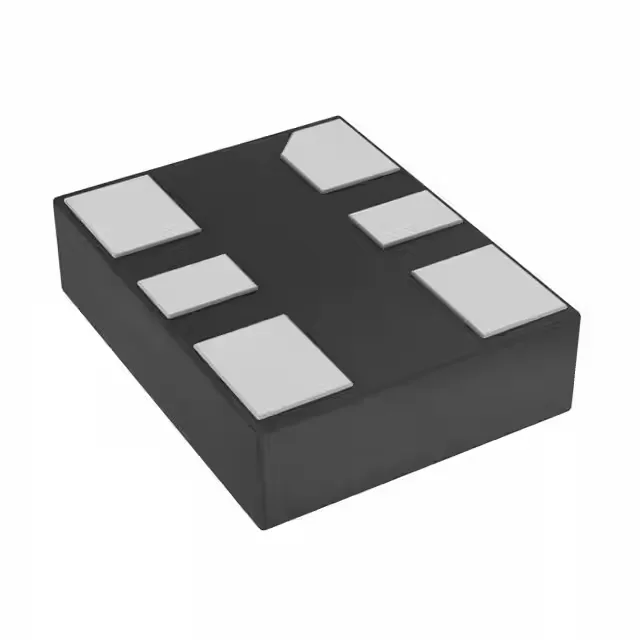
Microchip Technology DSC1122CE5-048.0000 — Crystals & Oscillators

DSC1122CE5-048.0000 MEMS XO, 48 MHz, LVPECL, ±10 ppm

MPNDSC1122CE5-048.0000
Active

Microchip DSC1122CE5-048.0000, XO (Standard), 48 MHz, LVPECL output, ±10 ppm stability, 2.25-3.6 V supply, -20°C to +70°C, 6-SMD no-lead package.

Sourced new & surplus through independent channelsAuthenticity-screened · ESD-safe packingListing updated Aug 2026

Specifications

DSC1122CE5-048.0000 specifications
ParameterValue
TypeXO (Standard)
SeriesDSC1122
MountingSurface Mount
Voltage2.25V ~ 3.6V
Current - supply58mA
Current - supply (Disable)22mA
Frequency48 MHz
Frequency stability±10ppm
Operating temperature-20°C~70°C
Size (Dimension)0.126\" L x 0.098\" W (3.20mm x 2.50mm)
Height - seated0.035\" (0.90mm)
OutputLVPECL
PackageTube
FunctionEnable/Disable
Base resonatorMEMS
Case6-SMD, No Lead

Product details

48 MHz LVPECL MEMS oscillator for high-speed clock trees

The DSC1122CE5-048.0000 is a MEMS-based XO (Standard) from Microchip's DSC1122 series, delivering a 48 MHz LVPECL output with ±10 ppm frequency stability over -20°C to +70°C. LVPECL differential signaling makes this part suitable for low-jitter clock distribution in 1000BASE-T Ethernet PHYs, FPGA reference clocks, and high-speed SerDes applications where a standard CMOS output would introduce excessive phase noise.

The oscillator operates from a single 2.25V to 3.6V supply, drawing 58 mA max when enabled and 22 mA max when disabled via the Enable/Disable function.

MEMS resonator advantage over quartz

A quartz oscillator at the same 48 MHz and ±10 ppm would typically require a larger package or external compensation; the MEMS approach keeps the footprint at 3.20 mm x 2.50 mm with a seated height of 0.90 mm.

Frequently asked questions

Can I use DSC1122CE5-048.0000 as a replacement for a quartz oscillator?

Yes, if the original quartz oscillator was a 48 MHz LVPECL device in a 6-SMD no-lead package with a 2.25-3.6 V supply. The MEMS resonator provides better shock and vibration tolerance, but the electrical interface is identical.