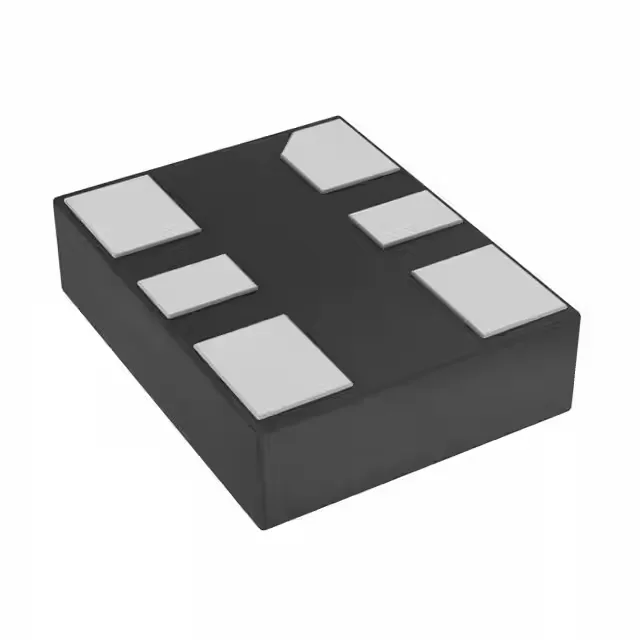
Microchip Technology DSC1122CE2-150.0000 — Crystals & Oscillators

DSC1122CE2-150.0000 – 150 MHz LVPECL MEMS Oscillator

MPNDSC1122CE2-150.0000
Active

Microchip DSC1122CE2-150.0000, XO (Standard) MEMS oscillator, 150 MHz, LVPECL output, ±25 ppm stability, 2.25V–3.6V supply, -20°C to 70°C, 6-SMD no-lead package.

Independent supplier — new & surplus stockAuthenticity-screened · ESD-safe packingListing updated Aug 2026

Specifications

DSC1122CE2-150.0000 specifications
ParameterValue
TypeXO (Standard)
SeriesDSC1122
MountingSurface Mount
Supply voltage2.25V ~ 3.6V
Current - supply58mA
Current - supply (Disable)22mA
Frequency150 MHz
Frequency stability±25ppm
Operating temperature-20°C~70°C
Size (Dimension)0.126\" L x 0.098\" W (3.20mm x 2.50mm)
Height - seated0.035\" (0.90mm)
OutputLVPECL
PackageTube
FunctionEnable/Disable
Base resonatorMEMS
Case6-SMD, No Lead

Product details

150 MHz LVPECL clock source with MEMS reliability

The DSC1122CE2-150.0000 is a 150 MHz XO (Standard) oscillator built on a MEMS resonator rather than a quartz crystal, delivering LVPECL output levels across a 2.25V to 3.6V supply range.

The 6-SMD, no-lead package measures 3.20 mm x 2.50 mm with a seated height of 0.90 mm, fitting standard high-density timing footprints.

Frequently asked questions

What is the output type of DSC1122CE2-150.0000?

LVPECL — Low-Voltage Positive Emitter-Coupled Logic. The output swing is differential and requires proper termination (typically 50 Ω to VCC – 2 V) for clean signal integrity at 150 MHz.

What supply voltage range does DSC1122CE2-150.0000 accept?

2.25V to 3.6V. This covers 2.5V and 3.3V nominal rails without an external LDO, simplifying power distribution in mixed-voltage systems.

Does DSC1122CE2-150.0000 have an enable/disable function?

Yes. The Enable/Disable pin allows the output to be tri-stated while the oscillator continues running internally. When disabled, the supply current drops to a maximum of 22 mA from 58 mA.

Is DSC1122CE2-150.0000 a quartz or MEMS oscillator?

MEMS. The base resonator is a silicon MEMS structure, not a quartz crystal. MEMS oscillators typically offer better shock and vibration tolerance, faster startup, and shorter lead times compared to quartz-based equivalents.