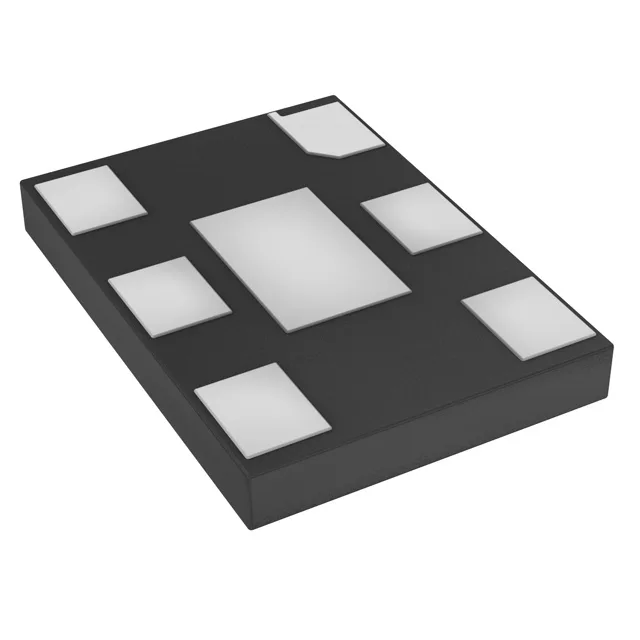
Microchip Technology DSC1122AI1-150.0000T — Crystals & Oscillators

DSC1122AI1-150.0000T Microchip MEMS XO, 150 MHz LVPECL

MPNDSC1122AI1-150.0000T
Active

Microchip DSC1122AI1-150.0000T, XO (Standard), 150 MHz, LVPECL output, ±50 ppm stability, -40°C to 85°C, 2.25V-3.6V supply, 6-SMD 7.0×5.0 mm package.

Independent supplier — new & surplus stockAuthenticity-screened · ESD-safe packingListing updated Aug 2026

Specifications

DSC1122AI1-150.0000T specifications
ParameterValue
TypeXO (Standard)
SeriesDSC1122
MountingSurface Mount
Supply voltage2.25V ~ 3.6V
Current - supply58mA
Current - supply (Disable)22mA
Frequency150 MHz
Frequency stability±50ppm
Operating temperature-40°C~85°C
Size (Dimension)0.276\" L x 0.197\" W (7.00mm x 5.00mm)
Height - seated0.035\" (0.90mm)
OutputLVPECL
PackageTape & Reel (TR)
FunctionEnable/Disable
Base resonatorMEMS
Case6-SMD, No Lead Exposed Pad

Product details

150 MHz LVPECL MEMS XO — what it replaces and what it needs

The DSC1122AI1-150.0000T is a 150 MHz fixed-frequency XO built on a MEMS resonator rather than a quartz crystal — the output is LVPECL, a differential 3.3 V / 2.5 V logic family that drives 50-Ω terminated transmission lines directly without an external buffer.

7.0×5.0 mm footprint — layout checklist

LVPECL output is DC-coupled to the load — the termination resistors (typically 50 Ω to Vcc-2 V) sit close to the receiver pin; the PCB trace impedance must be controlled to 50 Ω single-ended, 100 Ω differential.

Frequently asked questions

What is the output type of DSC1122AI1-150.0000T?

LVPECL — a differential 3.3 V / 2.5 V logic family that drives 50-Ω terminated lines directly. It is not compatible with LVCMOS or LVDS inputs without a level translator or AC-coupling network.

What supply voltage range does DSC1122AI1-150.0000T accept?

2.25 V to 3.6 V.

Can DSC1122AI1-150.0000T replace a standard 150 MHz quartz crystal oscillator?

Functionally yes — it provides the same 150 MHz clock with ±50 ppm stability. The difference is the MEMS resonator (no quartz blank) and the LVPECL output (differential, not single-ended LVCMOS). The board must have the correct termination resistors and a controlled-impedance trace pair for the LVPECL signal.