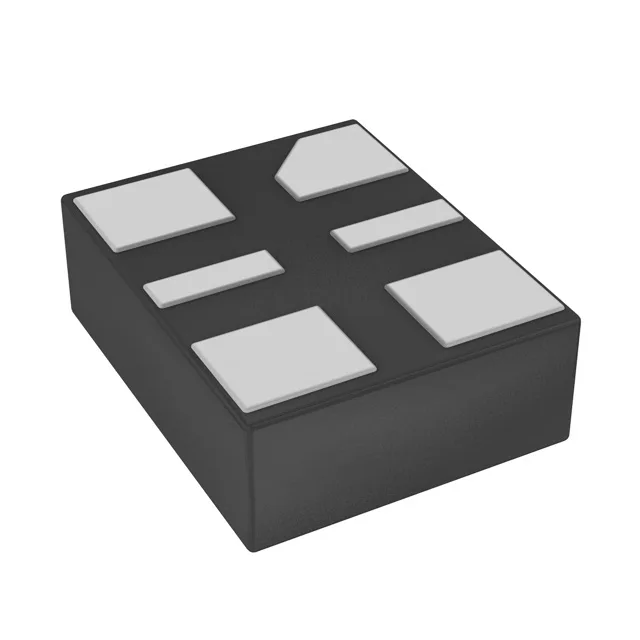
Microchip Technology DSC1121DL2-040.0000T — Crystals & Oscillators

DSC1121DL2-040.0000T – Microchip MEMS XO, 40 MHz, CMOS

MPNDSC1121DL2-040.0000T
Active

Microchip DSC1121 series MEMS XO, 40 MHz CMOS output, ±25 ppm stability, 2.25V-3.6V supply, -40°C to 105°C, AEC-Q100, 6-SMD no-lead package, tape & reel.

Sourced new & surplus through independent channelsAuthenticity-screened · ESD-safe packingListing updated Aug 2026

Specifications

DSC1121DL2-040.0000T specifications
ParameterValue
TypeXO (Standard)
SeriesDSC1121
MountingSurface Mount
Voltage2.25V ~ 3.6V
Current - supply35mA
Current - supply (Disable)22mA
Frequency40 MHz
Frequency stability±25ppm
Operating temperature-40°C~105°C
Size (Dimension)0.098\" L x 0.079\" W (2.50mm x 2.00mm)
Height - seated0.035\" (0.90mm)
OutputCMOS
PackageTape & Reel (TR)
RatingsAEC-Q100
FunctionEnable/Disable
Base resonatorMEMS
Case6-SMD, No Lead

Product details

The DSC1121DL2-040.0000T is a 40 MHz MEMS-based XO (Standard) with CMOS output, rated across -40°C to 105°C and qualified to AEC-Q100 — the under-hood temperature band where a quartz oscillator's frequency drift or startup failure would cause a missed CAN frame or a sensor read timeout. Supply voltage spans 2.25V to 3.6V, covering both 2.5V and 3.3V logic rails from a single rail — no separate LDO needed for the oscillator supply.

MEMS resonator vs quartz — shock tolerance and startup

MEMS oscillators have inherently higher shock and vibration tolerance — relevant for engine-bay and transmission-mounted ECUs where quartz crystals can fracture or exhibit microphonic frequency modulation. Startup time for MEMS oscillators is typically under 5 ms, compared to 10-20 ms for a quartz crystal with load capacitors — the Enable/Disable pin on this part lets the system hold the output in tri-state until the supply rail is stable, then release it without waiting for a crystal to resonate.

Active production — AEC-Q100 traceability

The 6-SMD no-lead package (2.50mm x 2.00mm, 0.90mm seated height) is a standard footprint shared across the DSC1121 family — the same PCB land pattern serves any frequency in the series, simplifying BOM consolidation.

Frequently asked questions

What is the Enable/Disable function on the DSC1121?

The Enable/Disable pin tri-states the CMOS output when pulled low, reducing supply current from 35 mA (max) to 22 mA (max). This allows the system to gate the clock during sleep modes or boundary-scan testing without removing power from the oscillator.

How does the DSC1121 compare to a quartz oscillator for automotive use?

The DSC1121 uses a MEMS resonator instead of a quartz crystal. MEMS oscillators are more resistant to shock and vibration — a known failure mode for quartz in engine-bay and transmission applications. The AEC-Q100 qualification covers the same reliability stress tests as quartz oscillators, but the MEMS die is inherently less sensitive to mechanical resonance and microphonics.