AEC-Q100 MEMS oscillator for automotive and industrial clocks
The AEC-Q100 qualification means this part is tested and documented for automotive reliability — suitable for engine control units, body controllers, or infotainment modules where a quartz crystal might drift or fail under vibration. The MEMS resonator is inherently more shock-tolerant than a quartz blank, which simplifies pick-and-place handling and reduces the risk of start-up failures in high-vibration environments.
Supply voltage flexibility and enable/disable control
The device operates from a 2.25V to 3.6V supply, covering common 2.5V, 3.0V, and 3.3V rails without an external regulator. The Enable/Disable function lets a system controller gate the clock output — useful for power-saving sleep modes or for isolating a peripheral during debug. Maximum supply current is 35 mA when enabled and 22 mA when disabled, so the disable state still draws some current; for ultra-low-power sleep, a load switch ahead of the oscillator's supply pin may be needed.
Package, footprint, and reflow considerations
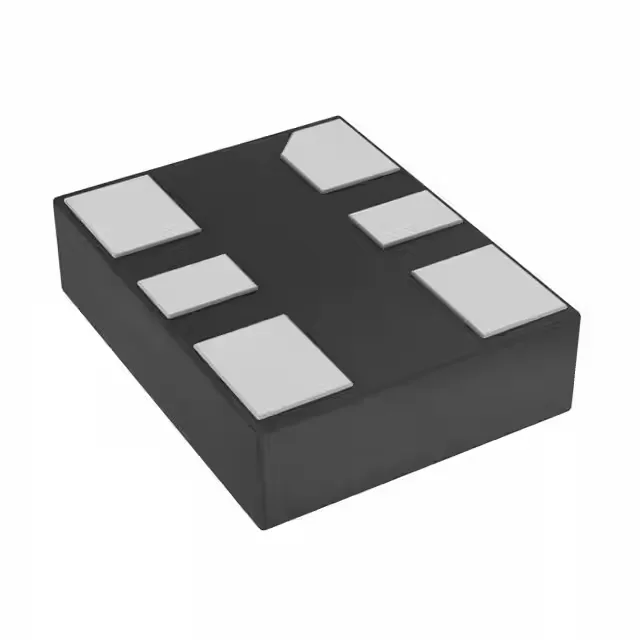
Housed in a 6-SMD, No Lead package measuring 3.20 mm x 2.50 mm with a seated height of 0.90 mm, this oscillator fits a standard 3.2 x 2.5 mm land pattern. The no-lead construction means the terminations are flush with the package body — no gull-wing leads to inspect, but the pad-to-pad spacing is tight. Check the MSL rating on the reel label before reflow; if it's MSL 3 or higher and the part has been exposed to ambient humidity, a bake cycle is needed to prevent popcorning. The small footprint suits space-constrained designs, but the 0.90 mm height may conflict with low-profile enclosures — verify clearance in the mechanical stack-up.