MEMS resonator vs quartz — what the temp range means
A quartz oscillator at these extremes often suffers from frequency jumps or startup failures due to crystal aging and drive-level sensitivity. The MEMS resonator in this part does not have a crystal blank that can crack or change mode, so it holds frequency through thermal cycling and mechanical shock — relevant for avionics, downhole logging, and satellite bus clocks where a quartz failure would be a mission event.
The supply range spans 2.25V to 3.6V, covering 2.5V and 3.3V logic rails without an external regulator.
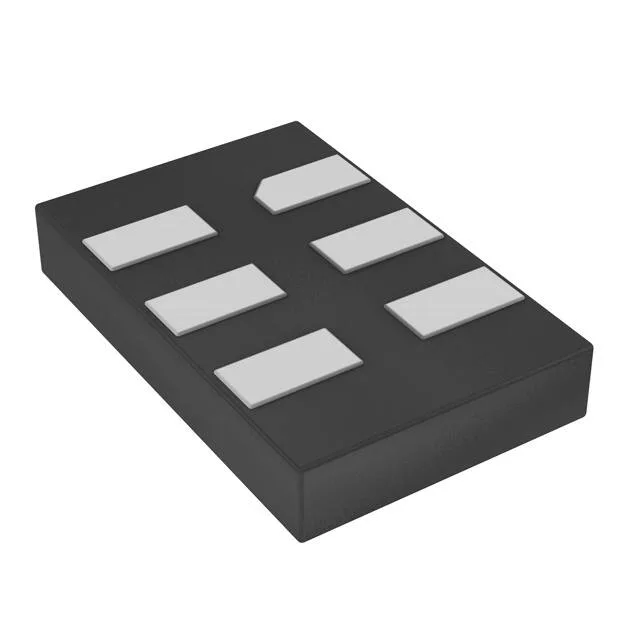
Housed in a 6-SMD, no-lead package measuring 5.00 mm x 3.20 mm with a seated height of 0.90 mm. The no-lead footprint has a large ground pad underneath — the datasheet's recommended layout uses via-in-pad to the ground plane for thermal relief and to keep the MEMS die's substrate at a stable temperature. The 0.90 mm height fits under many mezzanine boards or within a 1.0 mm keep-out zone.