MEMS oscillator at 41.5 MHz — why it replaces quartz
The DSC1121AI5-041.5000T is a MEMS-based XO (Standard) from Microchip's DSC1121 series, delivering a fixed 41.5 MHz CMOS output with ±10 ppm frequency stability across the full -40 to 85°C industrial range. Unlike a quartz crystal oscillator, the MEMS resonator is immune to vibration-induced frequency shifts and has no start-up reliability issues — a common failure mode in high-shock environments like motor drives or portable instrumentation. The 2.25V to 3.6V supply range means the same BOM line works on a 2.5V or 3.3V rail without a separate regulator; the Enable/Disable function lets the system shut the oscillator off when the clock tree is idle, drawing 22 mA max in disable.
Because it is a standard XO from a broad MEMS oscillator family, supply continuity is better than a niche quartz part. The MEMS die is sourced from a single Microchip fab, so there is no multi-source qualification risk — but the wide voltage range and CMOS output make it straightforward to cross-reference against other 41.5 MHz XOs if a second source is required.
Package and footprint — 6-VDFN with exposed pad
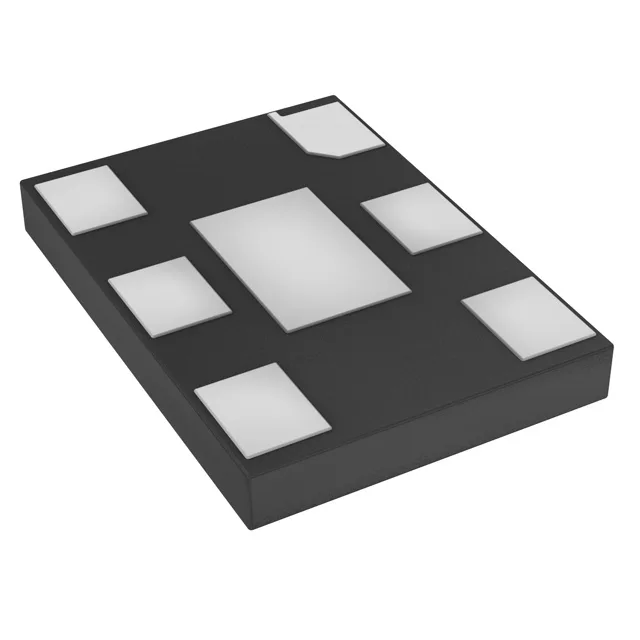
The 6-VDFN Exposed Pad package measures 7.00 mm x 5.00 mm with a seated height of 0.90 mm max. The 35 mA max supply current at 41.5 MHz is low enough that the thermal pad is more about mechanical stability than heat dissipation — but skipping the pad solder joint can cause intermittent clock loss under vibration, especially in the -40°C cold corner where solder contracts.