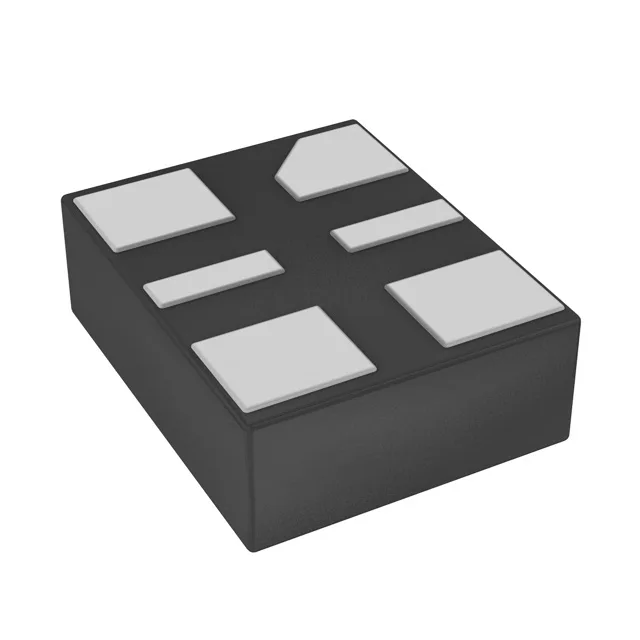
Microchip Technology DSC1104DL2-026.0000T — Crystals & Oscillators

DSC1104DL2-026.0000T MEMS XO, 26 MHz, HCSL

MPNDSC1104DL2-026.0000T
Active

Microchip DSC1104 series, XO (Standard), 26 MHz fixed frequency, HCSL output, MEMS resonator, 2.25V–3.6V supply, ±25 ppm APR, -40°C to 105°C, 6-VDFN package

Sourced new & surplus through independent channelsAuthenticity-screened · ESD-safe packingListing updated Aug 2026

Specifications

DSC1104DL2-026.0000T specifications
ParameterValue
TypeXO (Standard)
SeriesDSC1104
MountingSurface Mount
Voltage2.25V ~ 3.6V
Current - supply42mA
Current - supply (Disable)95µA
Frequency26 MHz
Operating temperature-40°C~105°C
Size (Dimension)0.098\" L x 0.079\" W (2.50mm x 2.00mm)
Height - seated0.035\" (0.90mm)
OutputHCSL
PackageTape & Reel (TR)
FunctionStandby (Power Down)
Base resonatorMEMS
Case6-VDFN
Absolute pull range±25ppm

Product details

26 MHz MEMS oscillator with HCSL output and standby

The DSC1104DL2-026.0000T is a 26 MHz XO (Standard) built around a MEMS resonator, not a quartz crystal — no external load capacitors needed, and the frequency is set at the factory. The HCSL output (High-Speed Current Steering Logic) is the same signalling used on PCIe reference clocks, so this oscillator can feed a PCIe clock buffer or a SerDes PLL directly without a level translator. Supply voltage spans 2.25V to 3.6V, covering 2.5V and 3.3V rails without a separate regulator.

The 6-VDFN package (2.50mm × 2.00mm, 0.90mm seated height) is a compact land-grid array — the exposed pad on the bottom side should be soldered to a PCB thermal land for best heat transfer and mechanical stability. For a 26 MHz clock, ±25 ppm is ±650 Hz — tight enough for most Ethernet and USB controllers that specify ±50 ppm or looser.

Frequently asked questions

What is the standby current and how does the power-down function work?

When the enable pin is driven low (or left floating, depending on the logic polarity), the oscillator enters standby and draws 95 µA max from the supply. The output is tri-stated during standby. This lets a microcontroller or system controller gate the clock to save power without a separate load switch.