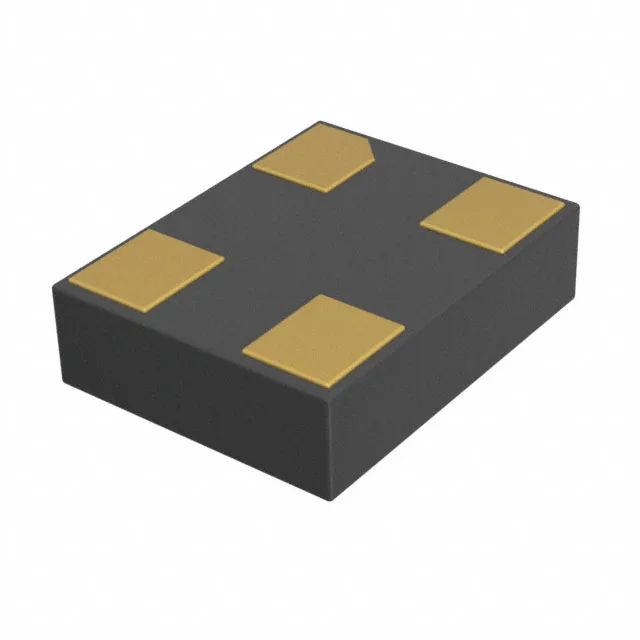
MEMS resonator replaces quartz — same function, different failure mode
The base resonator is a silicon MEMS structure, which means no quartz aging drift, no start-up reliability issues from crystal contamination, and faster start-up than a quartz oscillator. The 26 MHz LVDS output is a differential pair — the receiver termination must be 100 Ω across the lines, not a single-ended pull-up. Frequency stability is ±10 ppm across the full -40 to 105 °C range and the 2.25-3.63 V supply. That stability holds without the external load capacitors a quartz crystal needs — the MEMS resonator and the PLL are inside the package.
Standby function saves 95 µA in sleep mode
In a battery-powered sensor that wakes once a minute to transmit, gating the oscillator off between bursts saves more power than a separate load switch — the disable current is below the leakage of a typical P-FET switch.
Product status is Active. The 6-VDFN package measures 3.20 mm x 2.50 mm with a 0.90 mm seated height — the small footprint leaves room for decoupling caps near the supply pins.