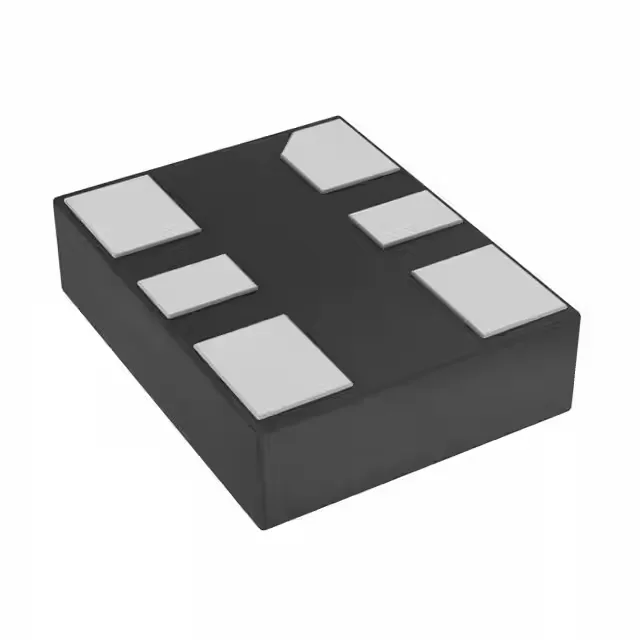
Microchip Technology DSC1103CI2-166.0000T — Crystals & Oscillators

DSC1103CI2-166.0000T MEMS Oscillator 166 MHz LVDS Active

MPNDSC1103CI2-166.0000T
Active

Microchip DSC1103 series MEMS-based XO, 166 MHz, LVDS output, ±25 ppm stability, 2.25 V–3.63 V supply, industrial temp, 6-SMD package, Tape & Reel

Sourced new & surplus through independent channelsAuthenticity-screened · ESD-safe packingListing updated Aug 2026

Specifications

DSC1103CI2-166.0000T specifications
ParameterValue
TypeXO (Standard)
SeriesDSC1103
MountingSurface Mount
Voltage2.25V ~ 3.63V
Current - supply32mA
Current - supply (Disable)95µA
Frequency166 MHz
Frequency stability±25ppm
Operating temperature-40°C~85°C
Size (Dimension)0.126\" L x 0.098\" W (3.20mm x 2.50mm)
Height - seated0.035\" (0.90mm)
OutputLVDS
PackageTape & Reel (TR)
FunctionStandby (Power Down)
Base resonatorMEMS
Case6-SMD, No Lead

Product details

166 MHz LVDS clock source for high-speed serial links

The DSC1103CI2-166.0000T is a MEMS-based XO delivering a 166 MHz LVDS output — the differential signalling keeps the edge rates clean for FPGA gigabit transceivers, PCIe reference clocks, or 10GbE PHY reference inputs without an external PLL cleanup. MEMS resonator eliminates the quartz start-up delay and vibration sensitivity: the oscillator is ready within microseconds of power-up and holds ±25 ppm stability across -40°C to +85°C, which covers the full industrial temperature band without a crystal oven.

Wide supply tolerance and standby power-down

Product status is Active.

6-SMD, no-lead package, 3.20 mm x 2.50 mm footprint, 0.90 mm seated height. The 0.50 mm pitch pads require standard 0.3 mm via or microvia fan-out on a two-layer board; a ground plane under the package improves EMI margin on the LVDS pair.

Frequently asked questions

What is the output type of DSC1103CI2-166.0000T?

LVDS differential output. The 166 MHz frequency and LVDS signalling make it a direct fit for high-speed serial clock distribution without an external level translator.

Can DSC1103CI2-166.0000T replace a standard quartz oscillator?

Functionally yes — it provides the same 166 MHz clock with LVDS output, but the MEMS resonator differs from quartz in start-up time (microseconds vs milliseconds) and vibration immunity. The 6-SMD footprint is common, but confirm the pad layout matches the existing quartz oscillator's pinout before substitution.

What is the difference between DSC1103CI2 and DSC1103CI1?

The evidence does not list the CI1 variant. The CI2 suffix typically denotes frequency stability grade or temperature range — check the DSC1103 series datasheet for the specific CI1 vs CI2 parameter table. On this part, stability is ±25 ppm over -40°C to +85°C.