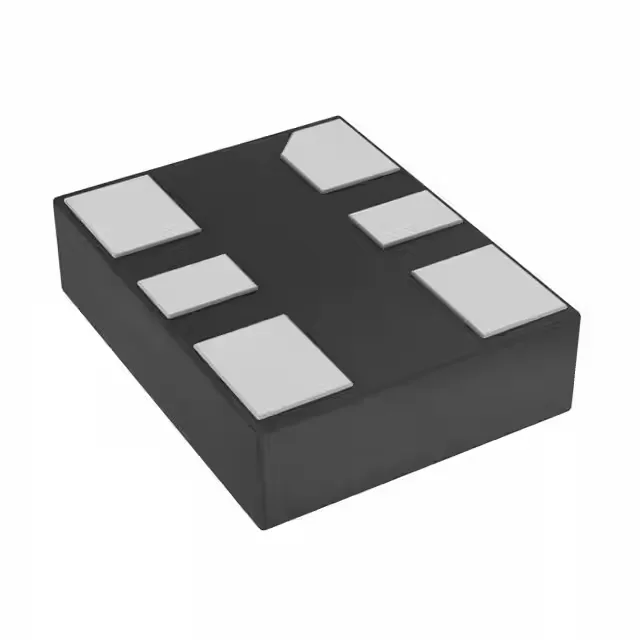
Microchip Technology DSC1103CI2-156.2500 — Crystals & Oscillators

DSC1103CI2-156.2500 MEMS XO 156.25 MHz LVDS – Microchip

MPNDSC1103CI2-156.2500
Active

Microchip DSC1103CI2-156.2500, XO (Standard), LVDS output, 156.25 MHz, ±25 ppm, -40°C to 85°C, 2.25V-3.63V supply, standby (power down) function, 6-SMD no lead package

Sourced new & surplus through independent channelsAuthenticity-screened · ESD-safe packingListing updated Aug 2026

Specifications

DSC1103CI2-156.2500 specifications
ParameterValue
TypeXO (Standard)
SeriesDSC1103
MountingSurface Mount
Voltage2.25V ~ 3.63V
Current - supply32mA
Current - supply (Disable)95µA
Frequency156.25 MHz
Frequency stability±25ppm
Operating temperature-40°C~85°C
Size (Dimension)0.126\" L x 0.098\" W (3.20mm x 2.50mm)
Height - seated0.035\" (0.90mm)
OutputLVDS
PackageTube
FunctionStandby (Power Down)
Base resonatorMEMS
Case6-SMD, No Lead

Product details

156.25 MHz LVDS reference for SerDes and FPGA clock trees

The DSC1103CI2-156.2500 is a MEMS-based XO delivering a 156.25 MHz LVDS output — a common reference frequency for 10 Gigabit Ethernet SerDes, PCIe Gen 3, and FPGA transceiver blocks. The LVDS differential pair provides the low-jitter edge rates these interfaces require, with a typical phase jitter that keeps the bit-error rate within the link budget. It operates from a 2.25V to 3.63V supply, covering both 2.5V and 3.3V rails without a separate LDO. The wide range also absorbs rail droop during load transients, which matters when the oscillator shares a supply with a switching regulator.

The 6-SMD no-lead package measures 3.20 mm x 2.50 mm with a seated height of 0.90 mm — a compact footprint that fits dense timing arrays on multi-layer boards. The no-lead construction reduces parasitic inductance on the output path compared to a gull-wing package, which helps preserve the LVDS signal integrity at 156.25 MHz.

Frequently asked questions

Does DSC1103CI2-156.2500 have a standby (power down) function?

Yes, the standby (power down) function is listed. When disabled, the supply current drops to 95 µA max, enabling power gating in battery-backed or duty-cycled systems.