What this MEMS oscillator does on your board
It operates from a 2.25V to 3.6V supply rail, so it can run directly off a 2.5V or 3.3V rail without an extra regulator. The wide tolerance also helps if your rail droops under load — the oscillator keeps running within spec. If your application needs better than ±25 ppm, you would look at the ±10 ppm variants in the same family.
The supply voltage range is 2.25V to 3.6V, covering 2.5V and 3.3V logic rails. Maximum supply current when active is 58 mA — that is the total draw of the MEMS core plus the LVPECL output buffer driving a terminated line. Pull the enable pin low, and the output goes high-impedance while the oscillator stops. This is useful for battery-powered systems that sleep between bursts of activity.
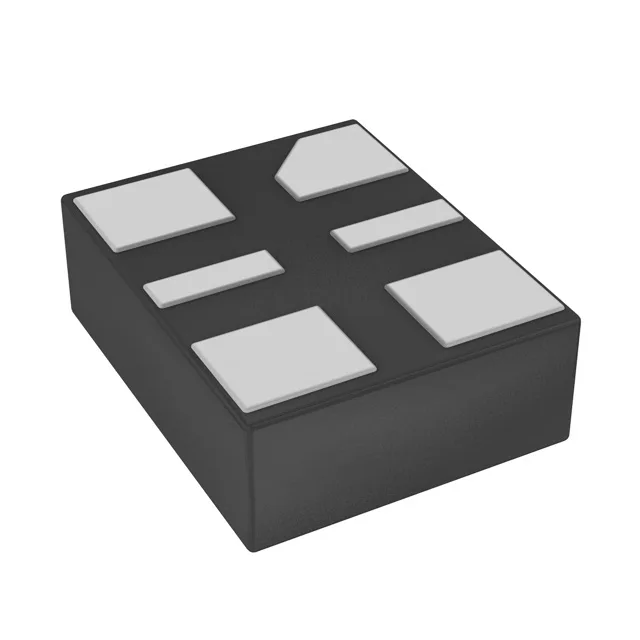
The 6-SMD, no-lead package measures 2.50 mm x 2.00 mm with a seated height of 0.90 mm — a compact footprint that fits tight layouts. Because the output is LVPECL, the traces should be routed as a differential pair with controlled impedance (typically 50 Ω to ground per line, with a 100 Ω differential termination at the receiver). The short package leads help keep the signal path clean at 50 MHz.