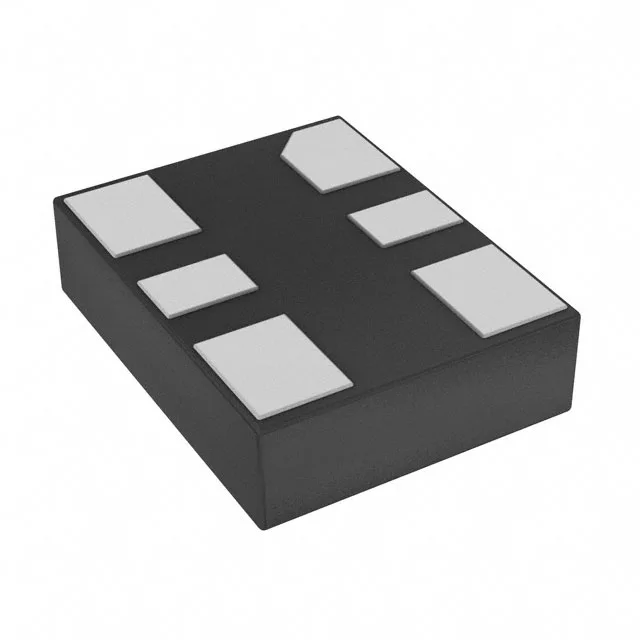
LVPECL output at 100 MHz — MEMS resonator, not quartz
LVPECL is the correct choice when the clock receiver expects a differential signal with a 1.6V common-mode voltage — common on high-speed FPGAs, SERDES, and 10G Ethernet PHYs. A single-ended LVCMOS oscillator will not drive these inputs without external level translation. MEMS oscillators typically start in under 5 ms versus tens of milliseconds for a quartz-based TCXO, and they survive 50,000 g shock — relevant for avionics, downhole tools, and portable instrumentation where the board sees vibration.
Supply voltage spans 2.25V to 3.6V, so the same oscillator works on a 2.5V or 3.3V rail without a dedicated LDO. Active supply current is 58 mA max at 100 MHz LVPECL. That figure includes the output driver current into a 50-Ω termination to VCC-2V — the standard LVPECL termination. If the load is lighter, actual current will be lower, but the 58 mA ceiling sets the thermal budget for the 6-SMD package.
Temperature grade and frequency stability
If the application requires ±25 ppm for Synchronous Ethernet or IEEE 1588, a different stability grade in the DSC1102 family would be needed.