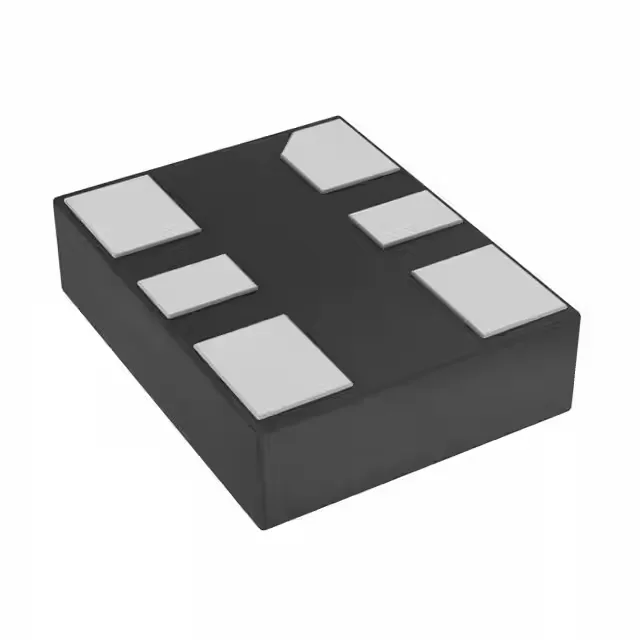
The DSC1102CI5-025.0000 delivers a 25 MHz LVPECL output. LVPECL is a differential, 50-ohm-terminated signal — it drives long PCB traces and noisy backplanes with better jitter margin than single-ended LVCMOS. Your receiver must have a differential input (e.g., an FPGA transceiver bank or a PHY clock input); a standard LVCMOS clock input will not work without an external level translator. The LVPECL output swing scales with Vdd — at 3.3 V the swing is roughly 800 mV p-p into 50 ohms to Vdd-2 V, which meets the input thresholds of most 3.3 V LVPECL receivers.
MEMS resonator — shock survival and startup time
MEMS oscillators typically survive 50,000 g shock and 70 g vibration — a quartz crystal might fracture under the same conditions. For a motor drive or outdoor radio enclosure that sees repetitive mechanical stress, the MEMS resonator holds frequency without the activity dips common to quartz. That is tighter than the ±25 ppm or ±50 ppm typical of many quartz XOs. If your Ethernet PHY or FPGA transceiver PLL requires ±50 ppm or better total link budget, this oscillator leaves margin for the rest of the clock tree.
That is low enough to leave the oscillator powered on a battery-backed rail without draining the coin cell. Active supply current is 58 mA max — typical for an LVPECL oscillator at 25 MHz, driven by the 50-ohm termination current.
The 6-SMD no-lead package measures 3.20 mm x 2.50 mm with a seated height of 0.90 mm. The 0.90 mm height fits under a heatsink or in a 10 mm card slot. The six pads include Vdd, GND, output, output complement, and enable — the two output pads are the differential pair; route them as 50-ohm coplanar striplines with a ground plane beneath. The package is supplied in tube. No via-in-pad is required — the thermal pad is small, and the 58 mA draw does not generate significant heat.