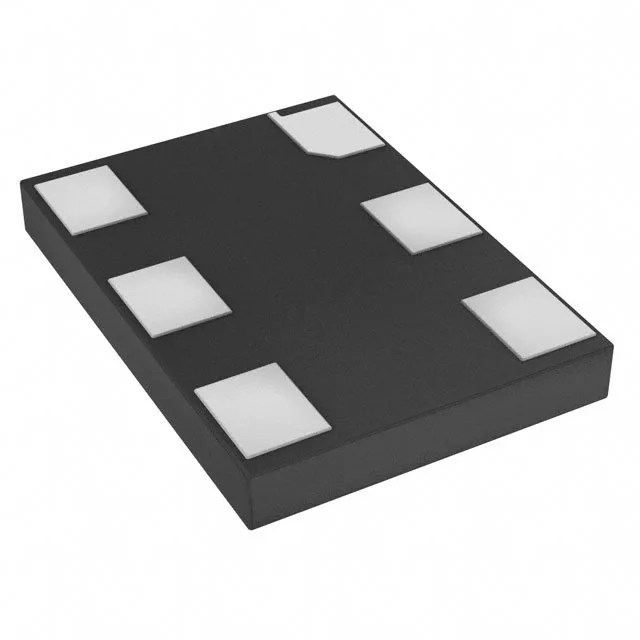
Microchip Technology DSC1101NI5-025.0000T — Crystals & Oscillators

DSC1101NI5-025.0000T MEMS XO – 25 MHz, CMOS, ±10 ppm, Active

MPNDSC1101NI5-025.0000T
Active

Microchip DSC1101 series MEMS XO (Standard), 25 MHz, CMOS output, ±10 ppm frequency stability, 6-SMD no-lead package, -40°C to 85°C, 2.25V to 3.6V supply.

Sourced new & surplus through independent channelsAuthenticity-screened · ESD-safe packingListing updated Aug 2026

Specifications

DSC1101NI5-025.0000T specifications
ParameterValue
TypeXO (Standard)
SeriesDSC1101
MountingSurface Mount
Voltage2.25V ~ 3.6V
Current - supply35mA
Current - supply (Disable)95µA
Frequency25 MHz
Frequency stability±10ppm
Operating temperature-40°C~85°C
Size (Dimension)0.276\" L x 0.197\" W (7.00mm x 5.00mm)
Height - seated0.035\" (0.90mm)
OutputCMOS
PackageTape & Reel (TR)
FunctionStandby (Power Down)
Base resonatorMEMS
Case6-SMD, No Lead

Product details

The DSC1101NI5-025.0000T is a 25 MHz MEMS-based XO (Standard) with CMOS output and ±10 ppm frequency stability — tighter than the ±25 ppm typical of many quartz oscillators, which buys extra timing margin for USB, Ethernet PHY, or CAN reference clocks without a separate temperature-compensation circuit. Supply voltage spans 2.25V to 3.6V, so the same part runs on a 2.5V or 3.3V rail without a level translator; the wide range also covers the tolerance band of a loosely regulated supply.

Standby mode and supply current

For a battery-powered sensor node that sleeps most of the time, the 35 mA active draw is cut to near-zero during the duty cycle, extending run time between charges.

6-SMD no-lead package

Housed in a 6-SMD, No Lead package measuring 7.00 mm x 5.00 mm with a seated height of 0.90 mm — a standard 7x5 mm oscillator footprint that matches many quartz XO land patterns.

Frequently asked questions

What is the standby power-down function on DSC1101NI5-025.0000T?

The Standby (Power Down) function disables the oscillator and reduces supply current to 95 µA max. The output goes high-impedance, allowing the clock line to be shared or pulled to a known state by an external resistor.