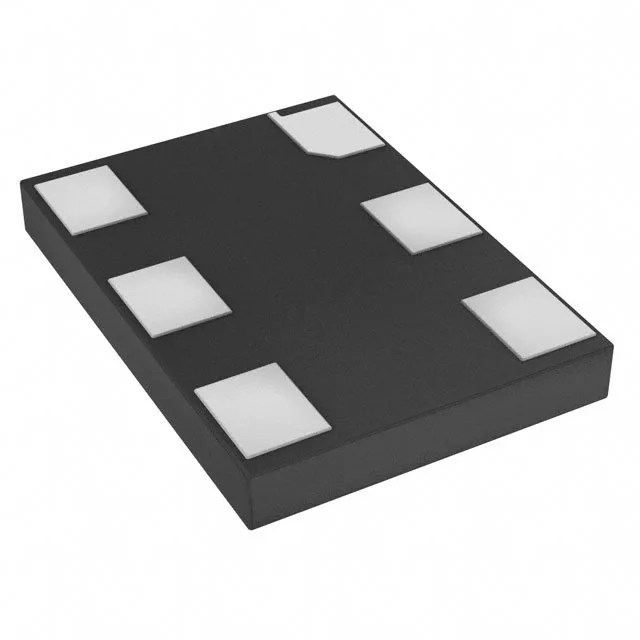
Microchip Technology DSC1101NI1-156.2500T — Crystals & Oscillators

DSC1101NI1-156.2500T – 156.25 MHz MEMS XO, CMOS

MPNDSC1101NI1-156.2500T
Active

Microchip Technology DSC1101NI1-156.2500T, XO (Standard) 156.25 MHz, CMOS output, MEMS resonator, 2.25 V–3.6 V supply, ±50 ppm stability, -40 to +85 °C, 6-SMD package, Tape & Reel.

Sourced new & surplus through independent channelsAuthenticity-screened · ESD-safe packingListing updated Aug 2026

Specifications

DSC1101NI1-156.2500T specifications
ParameterValue
TypeXO (Standard)
SeriesDSC1101
MountingSurface Mount
Voltage2.25V ~ 3.6V
Current - supply35mA
Current - supply (Disable)95µA
Frequency156.25 MHz
Frequency stability±50ppm
Operating temperature-40°C~85°C
Size (Dimension)0.276\" L x 0.197\" W (7.00mm x 5.00mm)
Height - seated0.035\" (0.90mm)
OutputCMOS
PackageTape & Reel (TR)
FunctionStandby (Power Down)
Base resonatorMEMS
Case6-SMD, No Lead

Product details

The DSC1101NI1-156.2500T is a fixed-frequency XO (Standard) delivering 156.25 MHz from a MEMS resonator, with CMOS output. That frequency sits in the range used for 10 GbE reference clocks, PCIe Gen 3/4 spread-spectrum references, and high-speed serial transceivers — the 156.25 MHz value is not arbitrary; it is the standard SerDes reference for 10 GbE and many FPGA transceiver banks. Supply voltage spans 2.25 V to 3.6 V, covering both 2.5 V and 3.3 V logic rails without a dedicated LDO. The wide range means the same oscillator can serve a 3.3 V FPGA bank and a 2.5 V SoC on the same board by tying the supply to the respective rail — no level translation needed on the output side because CMOS logic thresholds scale with VDD. The MEMS resonator does not exhibit the same frequency-vs-temperature inflection that quartz crystals show near 0 °C; the ±50 ppm stability holds across the full band without a temperature-compensation curve.

Package and footprint — 6-SMD, no lead

Housed in a 6-SMD, No Lead package measuring 7.00 mm x 5.00 mm with a seated height of 0.90 mm. The 0.276" x 0.197" footprint is a standard oscillator land pattern — it matches the common 7x5 mm ceramic SMD footprint used across the DSC1101 family and many quartz-based oscillators, so a single PCB layout can accommodate multiple sources.

Frequently asked questions

What is the frequency of DSC1101NI1-156.2500T?

156.25 MHz, fixed — the order code encodes it. This is the standard 10 GbE reference clock frequency, also used for PCIe Gen 3/4 spread-spectrum and many FPGA transceiver banks.

Is DSC1101NI1-156.2500T RoHS compliant?

The evidence does not list a specific RoHS status, but the 6-SMD, No Lead package is lead-free compatible by design. Confirm the specific date-code compliance with your distributor at RFQ.