125 MHz MEMS clock for industrial timing
Supply current is 95 µA maximum, which means the oscillator's own draw is negligible in a battery-powered sensor node or portable instrument — the system's sleep-current budget is dominated by the MCU and radio, not the clock.
Wide supply range and standby function
The supply voltage spans 2.25V to 3.6V, covering both 2.5V and 3.3V logic rails without an intermediate regulator. A single bypass capacitor at the VDD pin is sufficient for decoupling — the MEMS oscillator's internal LDO rejects supply ripple down to the noise floor of the output. This is useful in multi-rail designs where the oscillator must be disabled during low-power sleep modes.
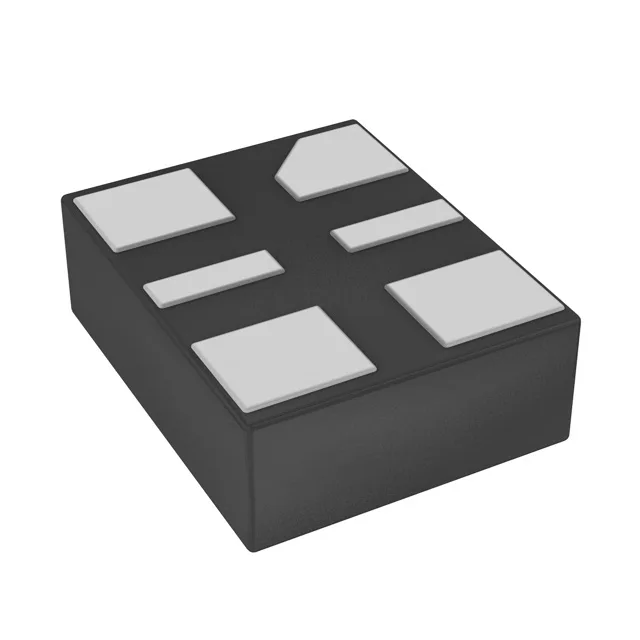
Housed in a 6-VDFN package measuring 2.50 mm x 2.00 mm with a seated height of 0.90 mm, the DSC1101DI1-125.0000T occupies less board area than a typical quartz SMD oscillator. The 0.50 mm pitch VDFN footprint requires a solder-mask-defined pad and a stencil aperture that matches the exposed pad dimensions — standard for QFN-style assembly. Surface-mount assembly on a 4-layer PCB is straightforward; the small package allows placement close to the load (FPGA, MCU, SerDes) to keep the clock trace short and minimise EMI coupling.