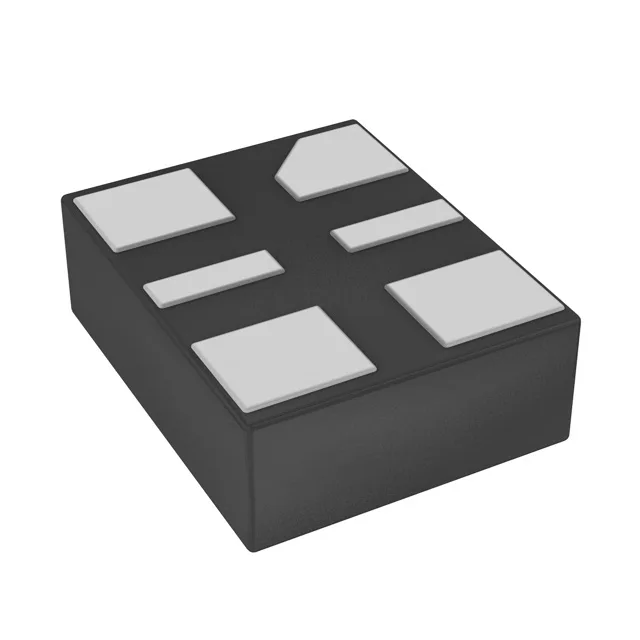
Microchip Technology DSC1101DI1-100.0000T — Crystals & Oscillators

DSC1101DI1-100.0000T Datasheet, Specs, Buy

MPNDSC1101DI1-100.0000T
Active

Microchip Technology DSC1101 series, XO (Standard) MEMS oscillator, 100 MHz, CMOS output, 2.25V–3.6V supply, ±50 ppm stability, -40°C to 85°C, 6-VDFN package

Independent supplier — new & surplus stockAuthenticity-screened · ESD-safe packingListing updated Aug 2026

Specifications

DSC1101DI1-100.0000T specifications
ParameterValue
TypeXO (Standard)
SeriesDSC1101
MountingSurface Mount
Supply voltage2.25V ~ 3.6V
Current - supply35mA
Frequency100 MHz
Frequency stability±50ppm
Operating temperature-40°C~85°C
Size (Dimension)0.098\" L x 0.079\" W (2.50mm x 2.00mm)
Height - seated0.035\" (0.90mm)
OutputCMOS
PackageTape & Reel (TR)
FunctionStandby (Power Down)
Base resonatorMEMS
Case6-VDFN

Product details

100 MHz MEMS oscillator for tight-timing sockets

Output is CMOS, so it drives a standard digital clock input directly; the supply range of 2.25V to 3.6V covers 2.5V and 3.3V rails without an external level translator.

Standby function and package footprint

Housed in a 6-VDFN measuring 2.50 mm x 2.00 mm with a seated height of 0.90 mm, the package fits a dense PCB layout; the 0.50 mm pitch pads require a standard NSMD land pattern with a via-in-pad only if the thermal pad is present.

Frequently asked questions

Is the DSC1101DI1-100.0000T compatible with a 3.3V logic rail?

Yes — the supply voltage range is 2.25V to 3.6V, so a 3.3V rail is within the operating envelope. The CMOS output swings rail-to-rail and drives a 3.3V clock input directly.

Does the DSC1101DI1-100.0000T have a pin-compatible alternative in the same family?

The DSC1121 series shares the same 6-VDFN package and pinout but offers a different feature set (enable/disable instead of standby). For a drop-in replacement with the standby function, stay within the DSC1101 series and select the same frequency and stability grade.

How does the DSC1101 MEMS oscillator compare to a traditional quartz oscillator?

A MEMS resonator is less sensitive to vibration and shock than a quartz crystal, and it starts up faster — typically under 5 ms vs 10–20 ms for a quartz oscillator. The trade-off is that the phase-noise floor at close-in offsets (1 kHz to 100 kHz) can be higher than a good quartz design, which matters for a low-jitter ADC or PLL reference.