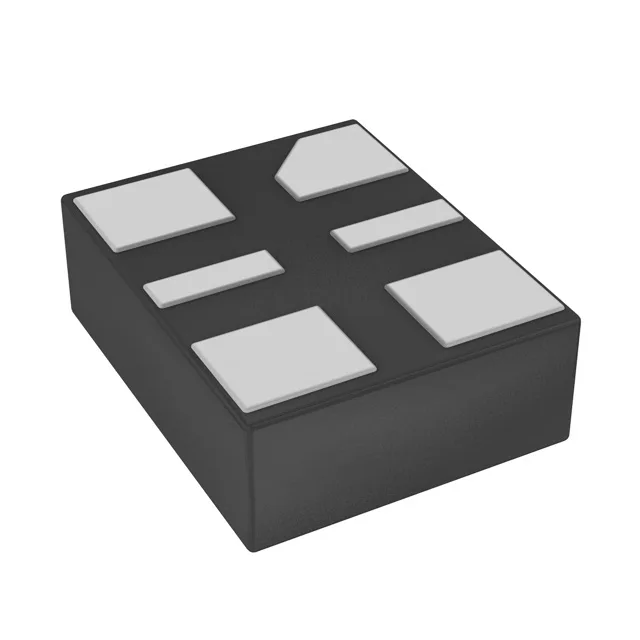
MEMS oscillator at 49.152 MHz — why not quartz
The 49.152 MHz frequency is a standard multiple for audio clocking and video pixel rates — it divides cleanly to 48 kHz and 32 kHz audio sample rates, making this a fit for HDMI receivers, USB audio interfaces, and broadcast video encoders. CMOS output means it drives standard logic inputs directly without an external level translator. The ±25 ppm frequency stability holds the timing budget across the full -20°C to 70°C range, so a 48 kHz audio clock stays within ±1 sample over a 10-second buffer.
95 µA supply current — battery-life fit
At 95 µA max supply current, this oscillator draws roughly one-tenth the current of a typical quartz-based XO at the same frequency. For a battery-powered device that runs 24/7, that difference extends runtime by months. The wide supply range of 2.25V to 3.6V means it can run directly from a 3.3V rail or a 2.5V rail without an LDO, and it tolerates a 2.8V Li-ion cell as it discharges. No external bypass capacitor is specified beyond the standard 0.1 µF — the MEMS core is inherently less sensitive to supply ripple than a quartz Pierce oscillator.
The 6-VDFN package (2.50 mm × 2.00 mm, 0.90 mm seated height) is a standard MEMS oscillator footprint shared across the DSC1101 series, so a pin-compatible frequency change or second-source qualification is straightforward if the BOM needs flexibility.