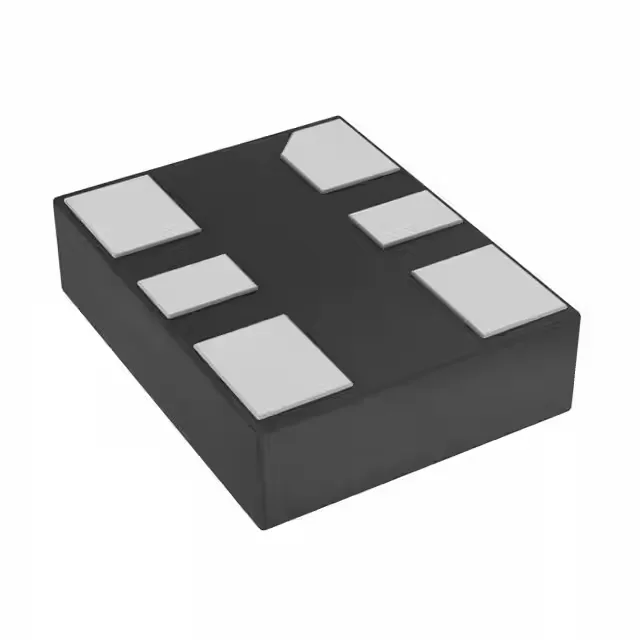
Microchip Technology DSC1101CL2-020.0000 — Crystals & Oscillators

DSC1101CL2-020.0000 MEMS XO 20 MHz ±25ppm -40°C~105°C

MPNDSC1101CL2-020.0000
Active

Microchip Technology DSC1101 series XO (Standard), 20 MHz CMOS output, ±25ppm stability, 2.25V~3.6V supply, Standby (Power Down) function, -40°C~105°C, 6-SMD No Lead package.

Independent supplier — new & surplus stockAuthenticity-screened · ESD-safe packingListing updated Aug 2026

Specifications

DSC1101CL2-020.0000 specifications
ParameterValue
TypeXO (Standard)
SeriesDSC1101
MountingSurface Mount
Supply voltage2.25V ~ 3.6V
Current - supply35mA
Current - supply (Disable)95µA
Frequency20 MHz
Frequency stability±25ppm
Operating temperature-40°C~105°C
Size (Dimension)0.126\" L x 0.098\" W (3.20mm x 2.50mm)
Height - seated0.035\" (0.90mm)
OutputCMOS
PackageTube
FunctionStandby (Power Down)
Base resonatorMEMS
Case6-SMD, No Lead

Product details

Active production — 20 MHz MEMS XO for industrial timing

The 2.25V to 3.6V supply range lets the oscillator run from a 2.5V or 3.3V rail without an external LDO.

Package footprint and board layout

Housed in a 6-SMD No Lead package measuring 3.20mm x 2.50mm with a seated height of 0.90mm. The 0.50mm pitch pads require a clean solder-paste stencil aperture and a via-in-pad escape for the centre ground pad if the datasheet recommends it.

Frequently asked questions

How does a MEMS oscillator compare to a quartz crystal oscillator?

A MEMS resonator is less sensitive to shock and vibration than a quartz crystal, and it typically starts up faster (microseconds vs milliseconds). The trade-off is that the phase-noise floor may be higher than a good quartz oscillator, so for jitter-sensitive PLLs or high-speed ADCs, check the phase-noise plot in the datasheet — the ±25ppm stability here is comparable to a standard quartz XO.

What is the standby function on DSC1101CL2-020.0000?

The Standby (Power Down) pin disables the output and shuts down the oscillator core, drawing 95µA max. When the pin is de-asserted, the output resumes after the startup time. This is a hardware gating signal — it does not require an I2C or SPI command.