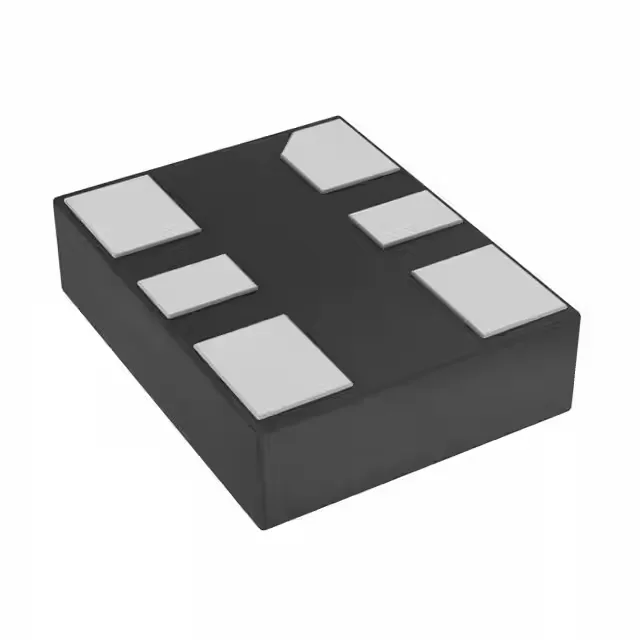
Microchip Technology DSC1101CI2-133.0000 — Crystals & Oscillators

DSC1101CI2-133.0000 MEMS XO – 133 MHz, CMOS, ±25 ppm

MPNDSC1101CI2-133.0000
Active

Microchip Technology DSC1101CI2-133.0000, a MEMS-based XO (Standard) delivering a 133 MHz CMOS output with ±25 ppm frequency stability across -40°C to 85°C, in a 6-VDFN package.

Sourced new & surplus through independent channelsAuthenticity-screened · ESD-safe packingListing updated Aug 2026

Specifications

DSC1101CI2-133.0000 specifications
ParameterValue
TypeXO (Standard)
SeriesDSC1101
MountingSurface Mount
Voltage2.25V ~ 3.6V
Current - supply35mA
Frequency133 MHz
Frequency stability±25ppm
Operating temperature-40°C~85°C
Size (Dimension)0.126\" L x 0.098\" W (3.20mm x 2.50mm)
Height - seated0.035\" (0.90mm)
OutputCMOS
PackageTube
FunctionStandby (Power Down)
Base resonatorMEMS
Case6-VDFN

Product details

MEMS resonator, 133 MHz fixed clock

For a 133 MHz clock feeding an FPGA or a high-speed serial transceiver, that means a cleaner edge on power-up and fewer timing surprises over the product life.

Supply range and standby power-down

The supply voltage range spans 2.25V to 3.6V, so it runs directly off a 2.5V or 3.3V rail without a secondary LDO.

Industrial temperature and ±25 ppm stability

If your design sees under-hood temperatures (125°C), you'll need the 'CI3' or 'CI5' suffix variants in the same DSC1101 family.

6-VDFN package and board layout

The 6-VDFN package measures 3.20 mm x 2.50 mm with a seated height of 0.90 mm — a compact footprint for dense PCB layouts. Hand-soldering is possible with a fine-tip iron and flux, but a hot-air rework station makes it easier; the pad pitch is 0.95 mm, so a steady hand and magnification help.

It is available for design-in and production.

Frequently asked questions

Does DSC1101CI2-133.0000 have a standby mode?

Yes, it has a Standby (Power Down) function. When the enable pin is pulled low, the output goes to high-impedance and the supply current drops to near zero.

Can DSC1101CI2-133.0000 replace a quartz-based 133 MHz oscillator?

It is a MEMS-based XO with the same 133 MHz CMOS output and ±25 ppm stability as many quartz oscillators. The pinout and footprint (6-VDFN) differ from common 4-pin DIP or SMD packages, so a PCB layout change is needed. Functionally it is a drop-in replacement for the clock signal, but the mechanical fit must be verified.