What this MEMS oscillator does on your board
The DSC1101CI2-060.0000T is a MEMS-based XO (Standard) that generates a 60 MHz clock output in CMOS logic levels — no external crystal or load capacitors needed, just a bypass cap on the supply pin. A MEMS resonator means faster startup than a quartz crystal (typically under 5 ms) and better resistance to shock and vibration, which matters if the board lives near a fan, motor, or in portable equipment that gets dropped.
Supply voltage and temperature range — where it fits
It belongs in outdoor telecom cabinets, factory-floor controllers, and engine-bay electronics where the ambient can swing from a cold winter start to a hot summer afternoon under load.
Standby pin and power-down current
A dedicated Standby (Power Down) pin lets you shut off the oscillator when the system sleeps — the disable current is 95 µA max, which is low enough that a battery-powered sensor node can leave the oscillator powered down between wake cycles without draining the cell. When active, the oscillator draws 35 mA max at 60 MHz — typical for a CMOS-output MEMS oscillator at this frequency; the supply decoupling should be a 0.1 µF ceramic right at the pin to keep the edge rates clean.
Package and PCB layout note
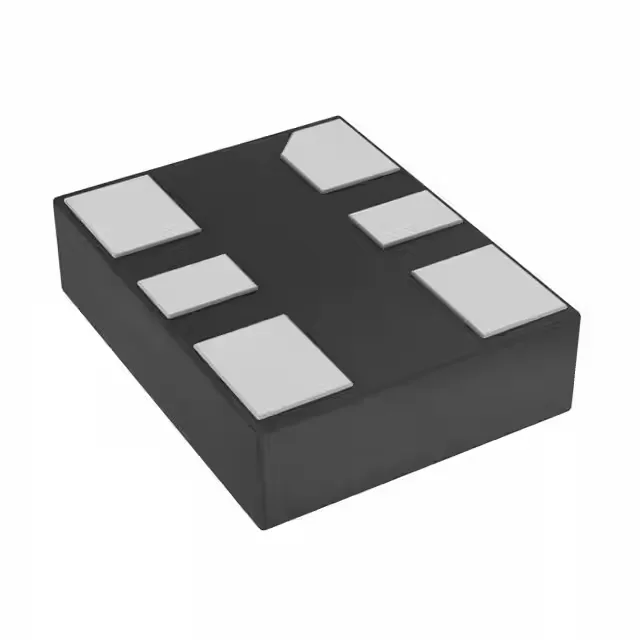
Housed in a 6-VDFN package measuring 3.20 mm x 2.50 mm with a seated height of 0.90 mm — this is a compact, low-profile footprint that fits under a shield can or on a dense mixed-signal board where every square millimeter counts. Surface-mount only; the VDFN has a center pad that should be soldered to a ground-plane island with thermal vias to keep the die temperature uniform. No special routing needed for the CMOS output — just a 50-ohm trace if the clock runs to a distant load.
This part is suitable for both new designs and ongoing production; no last-time-buy pressure.