The DSC1101CI1-085.2070T is a MEMS-based XO (Standard) oscillator from Microchip's DSC1101 series, delivering a fixed 85.207 MHz CMOS output. The MEMS resonator eliminates the quartz-crystal start-up time and vibration sensitivity — the oscillator is ready within microseconds of power-up and holds frequency through mechanical shock that would fracture a crystal blank. The ±50 ppm Absolute Pull Range (APR) covers frequency margining for spread-spectrum clocking or EMI reduction — the oscillator can be tuned across that window via the control voltage, though the datasheet should confirm the pull linearity and modulation bandwidth for your PLL loop filter design. The 6-VDFN package (3.20 mm × 2.50 mm) is a low-profile, surface-mount footprint — board layout should follow the recommended land pattern for the 0.50 mm pitch to avoid solder bridging.
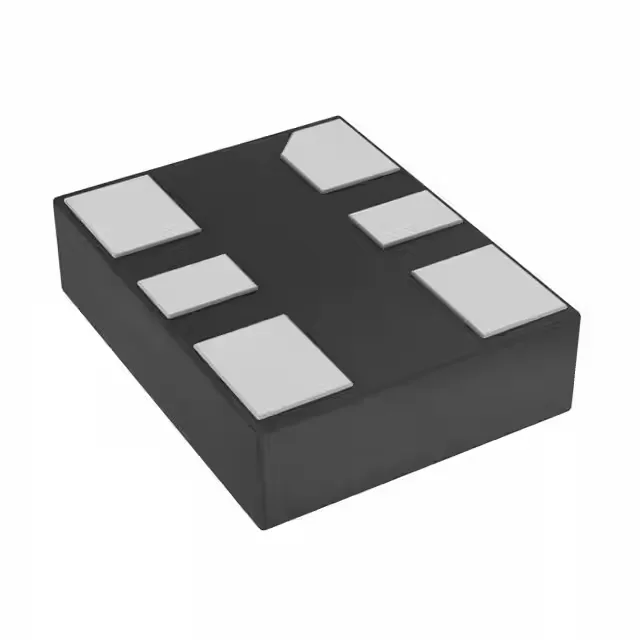
DSC1101CI1-085.2070T MEMS Oscillator – 85.207 MHz, CMOS
Microchip Technology DSC1101CI1-085.2070T, XO (Standard) MEMS oscillator, 85.207 MHz CMOS output, ±50 ppm APR, 2.25V–3.6V supply, -40°C to 85°C, 6-VDFN package, Tape & Reel.
Specifications
| Parameter | Value |
|---|---|
| Type | XO (Standard) |
| Series | DSC1101 |
| Mounting | Surface Mount |
| Voltage | 2.25V ~ 3.6V |
| Current - supply | 35mA |
| Current - supply (Disable) | 95µA |
| Frequency | 85.207 MHz |
| Operating temperature | -40°C~85°C |
| Size (Dimension) | 0.126\" L x 0.098\" W (3.20mm x 2.50mm) |
| Height - seated | 0.035\" (0.90mm) |
| Output | CMOS |
| Package | Tape & Reel (TR) |
| Function | Standby (Power Down) |
| Base resonator | MEMS |
| Case | 6-VDFN |
| Absolute pull range | ±50ppm |
Product details
Frequently asked questions
Does the DSC1101CI1-085.2070T operate at 3.3 V?
Yes. The supply voltage range is 2.25 V to 3.6 V, which includes 3.3 V.
What is the frequency tolerance of the DSC1101CI1-085.2070T?
The Absolute Pull Range (APR) is ±50 ppm. This is the tuning range available from the oscillator — the initial accuracy and temperature stability are part of that window, but the datasheet should be consulted for the specific tolerance over the full temperature range.
How does the DSC1101CI1-085.2070T compare to a standard quartz crystal oscillator?
The DSC1101 uses a MEMS resonator instead of a quartz crystal. MEMS oscillators typically offer faster start-up (microseconds vs milliseconds), better shock and vibration resistance, and a smaller footprint. The trade-off is that the frequency is factory-set — you cannot swap the crystal to change frequency as you would with a discrete crystal + PLL design. For a fixed 85.207 MHz clock, the MEMS oscillator is a drop-in replacement for a quartz XO with the same output type and package.