MEMS oscillator at 12 MHz — what it replaces
Supply range and standby for power-sensitive designs
Runs on any rail from 2.25V to 3.6V — one BOM line covers both 2.5V and 3.3V domains without a separate LDO.
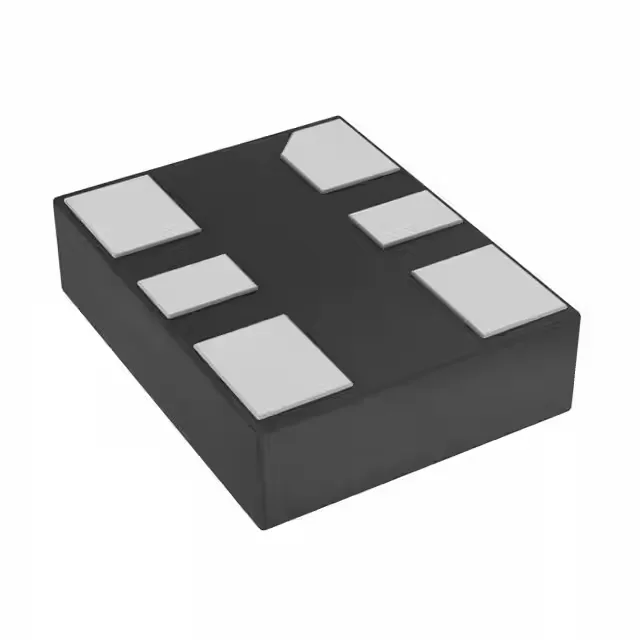
Microchip Technology DSC1101 series, XO (Standard) MEMS oscillator, 12 MHz, CMOS output, ±50 ppm frequency stability, -40°C to 85°C, 6-VDFN package
| Parameter | Value |
|---|---|
| Type | XO (Standard) |
| Series | DSC1101 |
| Mounting | Surface Mount |
| Supply voltage | 2.25V ~ 3.6V |
| Current - supply | 35mA |
| Frequency | 12 MHz |
| Frequency stability | ±50ppm |
| Operating temperature | -40°C~85°C |
| Size (Dimension) | 0.126\" L x 0.098\" W (3.20mm x 2.50mm) |
| Height - seated | 0.035\" (0.90mm) |
| Output | CMOS |
| Package | Tube |
| Function | Standby (Power Down) |
| Base resonator | MEMS |
| Case | 6-VDFN |
Runs on any rail from 2.25V to 3.6V — one BOM line covers both 2.5V and 3.3V domains without a separate LDO.
Yes, if the original oscillator is a 12 MHz CMOS-output XO in a similar 6-VDFN footprint. The MEMS resonator inside the DSC1101CI1-012.0000 gives faster start-up and better shock tolerance than a quartz oscillator, but the electrical interface (CMOS levels, supply range, standby pin) is the same. Verify the pinout and enable polarity against your board — the DSC1101 series uses a standard enable-high configuration.
This is the total frequency variation including temperature, supply, and aging. For a 12 MHz clock, ±50 ppm equals ±600 Hz — fine for MCU clocks and UART baud rates, but not for precision timing applications like a GPS PPS input.