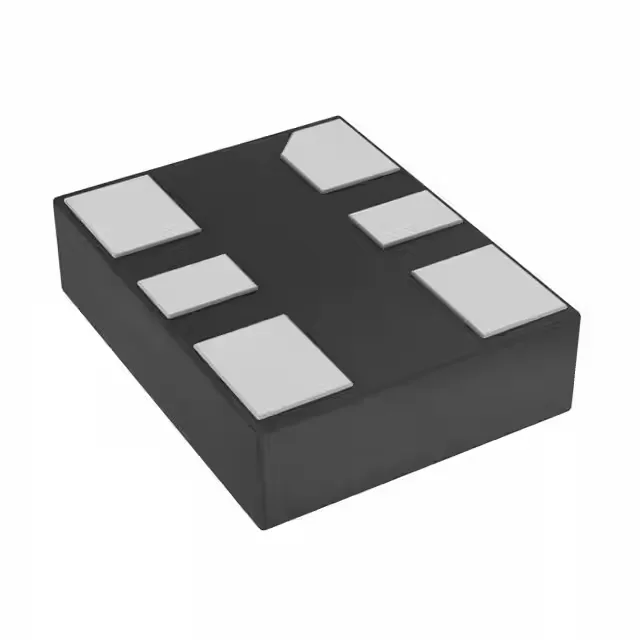
MEMS XO for 20 MHz CMOS clocking
This MEMS architecture eliminates the quartz crystal's mechanical resonance drift and start-up sensitivity — the frequency is set by a silicon MEMS die, not a quartz blank, which makes it more resistant to vibration and shock in industrial environments.
Supply and output compatibility
The CMOS output swings rail-to-rail, which means it drives standard CMOS logic inputs (including 3.3 V LVCMOS) with no level translation.
Frequency stability and temperature range
That 25 ppm window is the total variation including initial tolerance, temperature drift, and aging — for a 20 MHz carrier, the maximum frequency error is ±500 Hz. This is tight enough for most UART bit-rate clocks, USB full-speed, and general-purpose MCU oscillators, but not rated for precision Ethernet or wireless reference applications that demand ±10 ppm or better.
Housed in a 6-SMD, No Lead package measuring 3.20 mm x 2.50 mm with a seated height of 0.90 mm. The no-lead construction reduces parasitic inductance compared to a through-hole can, which helps maintain clean edges on the 20 MHz CMOS output.