MEMS oscillators start up faster (typically <5 ms vs 10+ ms for quartz) and survive higher shock and vibration — relevant if the board goes into a portable instrument, a fan-cooled enclosure, or anything that sees a drop test.
Power budget: 95 µA max across the supply range
Maximum supply current is 95 µA — that is the worst-case draw across the full 2.25 V to 3.6 V range. For a battery-powered sensor logging once per second, the oscillator's share of the sleep current is negligible; the MCU's own sleep current will dominate.
Temperature grade and fit for your BOM
It covers office equipment, home appliances, and factory-floor control cabinets that are climate-controlled. For Ethernet or USB full-speed, the ±10 ppm window is adequate; for high-speed USB (480 Mbps) you would typically need ±50 ppm or better, so this part fits.
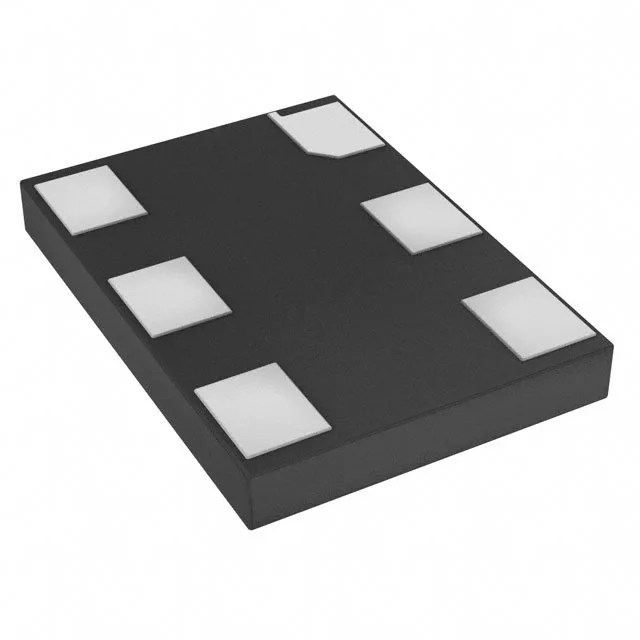
6-SMD No Lead package, 7.00 mm x 5.00 mm body, 0.90 mm seated height. The footprint is the same as a standard 7x5 mm quartz oscillator — the MEMS die sits inside the same ceramic package, so the PCB layout is a drop-in replacement for any 7x5 mm XO.