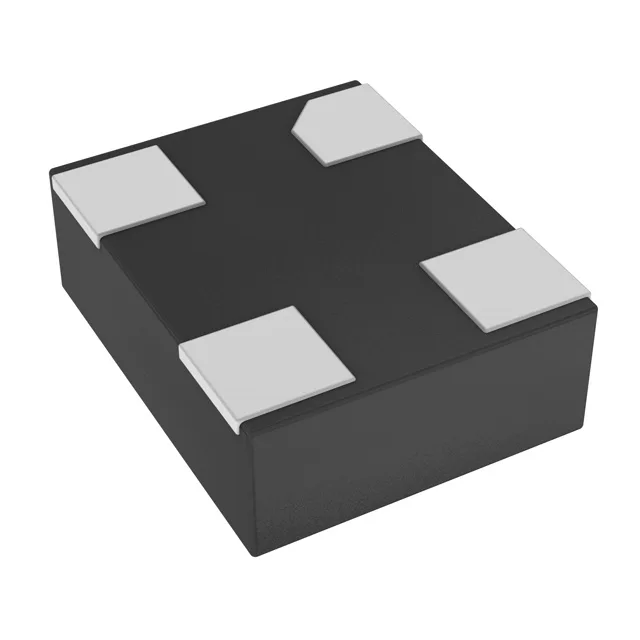
Microchip Technology DSC1033CI1-100.0000T — Crystals & Oscillators

DSC1033CI1-100.0000T MEMS Oscillator – Obsolete

MPNDSC1033CI1-100.0000T
Obsolete

Microchip DSC1033 PureSilicon™ MEMS XO, 100 MHz, CMOS output, 3.3V, ±50 ppm stability, -40°C~85°C, 4-SMD no-lead package

Independent supplier — new & surplus stockAuthenticity-screened · ESD-safe packingListing updated Jul 2026

Specifications

DSC1033CI1-100.0000T specifications
ParameterValue
TypeXO (Standard)
SeriesDSC1033, PureSilicon™
MountingSurface Mount
Supply voltage3.3V
Current - supply5mA (Typ)
Current - supply (Disable)1µA
Frequency100 MHz
Frequency stability±50ppm
Operating temperature-40°C~85°C
Size (Dimension)0.126\" L x 0.098\" W (3.20mm x 2.50mm)
Height - seated0.035\" (0.90mm)
OutputCMOS
PackageTape & Reel (TR)
FunctionStandby (Power Down)
Base resonatorMEMS
Case4-SMD, No Lead

Product details

The DSC1033CI1-100.0000T is a 100 MHz XO (standard oscillator) from Microchip's PureSilicon™ MEMS family, outputting CMOS logic levels from a 3.3V supply rail. Its MEMS base resonator replaces a quartz crystal with a silicon die, giving it shock and vibration tolerance suited for industrial environments across -40°C to 85°C. The 4-SMD no-lead package measures 3.20 mm x 2.50 mm with a seated height of 0.90 mm, fitting standard oscillator footprints for 100 MHz clock generation.

Typical supply current is 5 mA, dropping to 1 µA in standby (power-down) mode — the standby function lets the oscillator be gated off by a logic signal to save power in battery-backed designs.

Frequently asked questions

Is the DSC1033CI1-100.0000T compatible with standard 100 MHz CMOS logic?

Yes — the CMOS output at 3.3V supply directly drives standard 3.3V CMOS logic inputs at 100 MHz without a level translator.

What replaces the DSC1033CI1-100.0000T?

Microchip has not published an official successor for this obsolete order code. A functionally equivalent MEMS oscillator in the same 4-SMD footprint with 100 MHz, CMOS output, 3.3V, and ±50 ppm stability would be the closest drop-in candidate — confirm pin compatibility and standby function before committing a new BOM line.