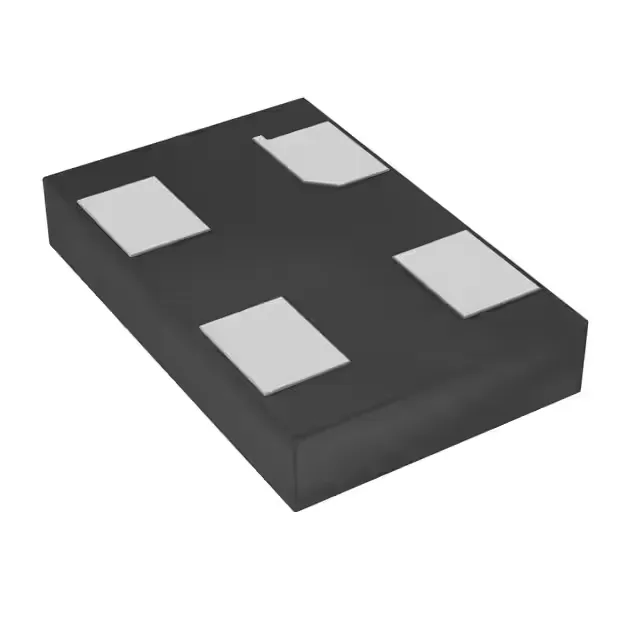
Microchip Technology DSC1004BI2-033.0000T — Crystals & Oscillators

DSC1004BI2-033.0000T MEMS Oscillator – AEC-Q100, 33 MHz

MPNDSC1004BI2-033.0000T
Active

Microchip DSC1004 series MEMS XO (Standard), 33 MHz, CMOS output, ±25 ppm stability, AEC-Q100 qualified, 4-SMD no-lead package, -40°C to 85°C.

Independent supplier — new & surplus stockAuthenticity-screened · ESD-safe packingListing updated Aug 2026

Specifications

DSC1004BI2-033.0000T specifications
ParameterValue
TypeXO (Standard)
SeriesDSC1004
MountingSurface Mount
Supply voltage1.8V ~ 3.3V
Current - supply8mA
Current - supply (Disable)15µA
Frequency33 MHz
Frequency stability±25ppm
Operating temperature-40°C~85°C
Size (Dimension)0.197\" L x 0.126\" W (5.00mm x 3.20mm)
Height - seated0.035\" (0.90mm)
OutputCMOS
PackageTape & Reel (TR)
RatingsAEC-Q100
FunctionStandby (Power Down)
Base resonatorMEMS
Case4-SMD, No Lead

Product details

Supply voltage and standby function

Temperature range and frequency stability

The ±25 ppm hold over temperature is tight enough for most MCU and communication PHY reference clocks — a 33 MHz signal drifts less than 825 Hz across the full range, keeping the PLL in lock without re-centering.

Housed in a 4-SMD, No Lead package measuring 5.00mm x 3.20mm with a seated height of 0.90mm. The 4-pin no-lead footprint is common for small oscillators — the pad layout matches industry-standard 5.0 x 3.2 mm MEMS and quartz XO footprints, so a board designed for a quartz part can take this MEMS part without a layout change.

Frequently asked questions

Is DSC1004BI2-033.0000T AEC-Q100 qualified?

Yes, it carries an AEC-Q100 rating, which means it has passed the automotive-grade qualification tests — temperature cycling, ESD, latch-up, and early-life failure rate — required for deployment in automotive ECUs and modules.

What is the difference between MEMS and crystal oscillators?

A MEMS oscillator uses a silicon micro-electromechanical resonator instead of a quartz crystal. The MEMS structure is inherently more resistant to shock and vibration, and the oscillator IC compensates for temperature drift electronically rather than relying on the crystal's cut angle. For the DSC1004BI2-033.0000T, the practical difference is better reliability in high-vibration environments like engine bays or industrial machinery.

What is the output type and frequency of DSC1004BI2-033.0000T?

It is a standard XO with CMOS output at 33 MHz. CMOS output is compatible with most digital logic families — no level translation needed for 1.8V, 2.5V, or 3.3V logic.