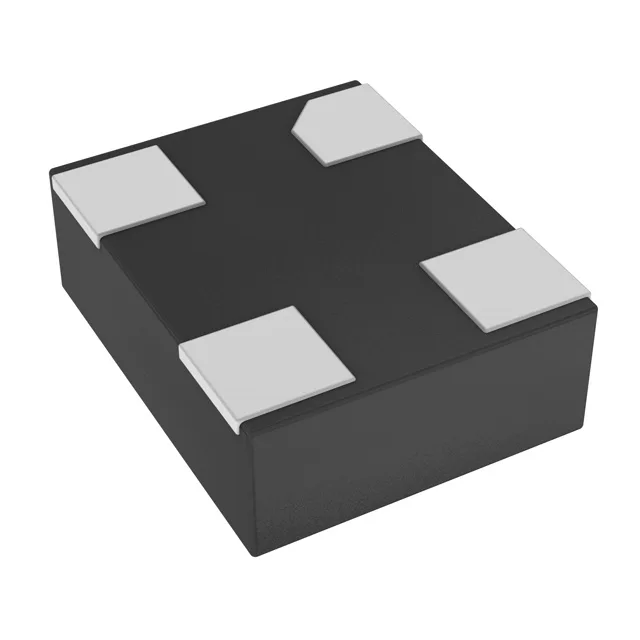
66.66 MHz MEMS oscillator for automotive timing
Its AEC-Q100 qualification means it's tested for automotive reliability stresses—thermal cycling, ESD, and latch-up—making it suitable for engine control units, ADAS camera modules, and infotainment head units where a quartz crystal might drift or fail under vibration. The standby (power down) function drops supply current to 15 µA, letting the oscillator share a power rail with a body controller's sleep-mode domain without draining the battery.
Supply voltage and power budget for multi-rail boards
The 1.8V to 3.3V supply range covers both core and I/O voltages found in modern automotive SoCs and FPGAs—no separate LDO needed for the oscillator rail. Maximum active supply current is 7.2 mA at 66.66 MHz; at 3.3 V that's under 24 mW, leaving thermal headroom in a sealed ECU enclosure.
Package footprint and hand-solderability
Housed in a 4-SMD, No Lead ceramic package measuring 2.50 mm × 2.00 mm with a seated height of 0.90 mm, it fits tight PCB stacks in camera modules or sensor pods. The 4-pad land pattern is hand-solderable with a fine-tip iron and magnification—a maker could breadboard it on an adapter, but for production a stencil and reflow profile matching the ceramic body's thermal mass is recommended.
The DSC1001 series remains a current design-in choice for automotive and industrial timing.