54 MHz MEMS XO with AEC-Q100 — the automotive clock that doesn't drift
The MEMS resonator eliminates the quartz crystal's cold-start and vibration sensitivity — a common failure point in engine-bay and chassis-mounted ECUs. AEC-Q100 qualification means this part has passed the automotive-grade reliability stress tests: temperature cycling, ESD, latch-up, and extended high-temperature operating life. It is suitable for under-hood and cabin-domain applications where a standard commercial oscillator would be rejected at PPAP.
Supply voltage range 1.8V to 3.3V — one part covers three rails
The wide supply range lets the same oscillator serve 1.8V, 2.5V, and 3.3V logic domains without a dedicated LDO. A 3.3V MCU and a 1.8V FPGA can share the same BOM line — the oscillator's output swing tracks the supply rail, so the CMOS input threshold is always met. Maximum supply current is 7.2 mA at 54 MHz — well within the budget of a typical automotive power tree. When the system enters sleep, the standby (power-down) function drops consumption to 15 µA max, preserving battery life in always-powered modules like a body controller or telematics unit.
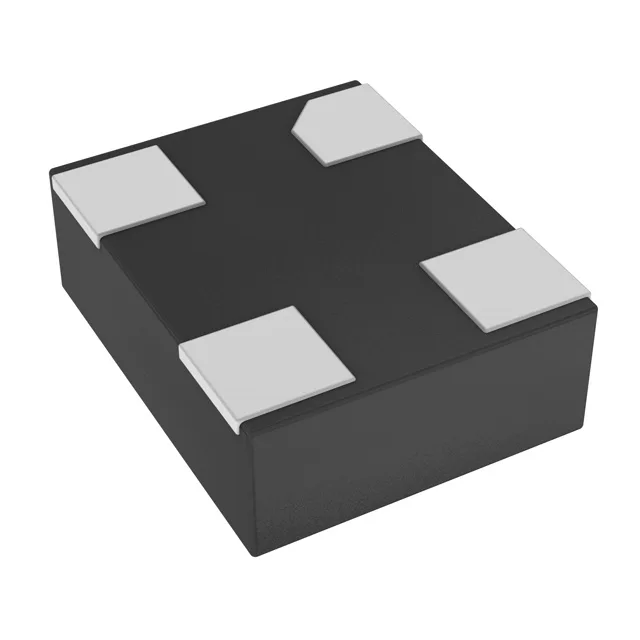
Package and footprint — 2.50 mm x 2.00 mm 4-SMD no-lead
The 4-SMD, no-lead package measures 2.50 mm x 2.00 mm with a seated height of 0.90 mm. The small footprint and low profile suit space-constrained automotive modules like camera ECUs or radar sensor boards. The no-lead construction reduces parasitic inductance compared to a through-hole crystal can, improving EMI margin at 54 MHz.