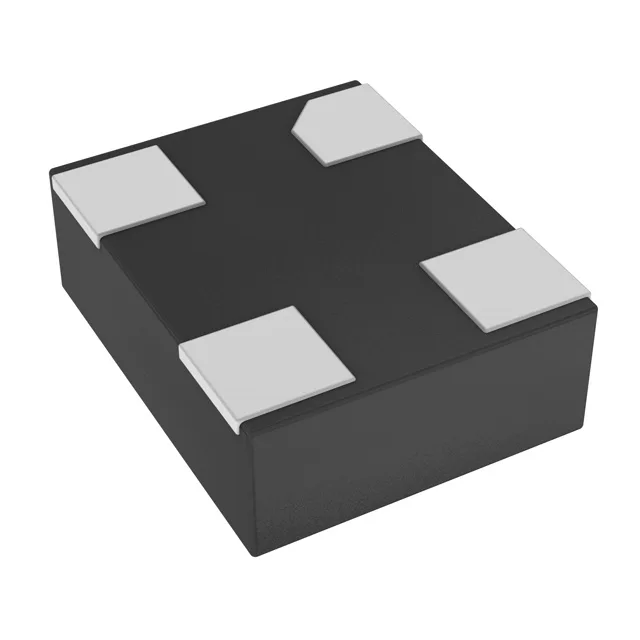
18.432 MHz fixed-frequency XO for automotive and industrial clocks
The DSC1001DI1-018.4320 is a MEMS-based XO (Standard) delivering a fixed 18.432 MHz CMOS output — a common frequency for UART baud-rate generation, CAN controllers, and MCU clock trees in automotive body electronics. Its AEC-Q100 qualification means it has passed the automotive-grade reliability stress tests: temperature cycling, ESD, and latch-up. That makes it a direct fit for under-hood and cabin modules where a standard quartz oscillator would require additional screening. The MEMS resonator base gives it better shock and vibration tolerance than a quartz crystal — relevant for engine-mount ECUs and transmission controllers that see constant mechanical stress.
Supply voltage flexibility and power budget
The 1.8V to 3.3V supply range means the same oscillator can be used across multiple voltage domains — a single BOM line covers both the 3.3V I/O bank and the 1.8V core clock on a mixed-voltage design. Maximum supply current is 6.3 mA — low enough that a small LDO or a direct rail tap can feed it without thermal concern. When disabled, the supply current drops to 15 µA, useful for sleep-mode power budgets in battery-backed modules.
Temperature range and frequency stability
No derating needed for outdoor telecom enclosures or engine-bay-adjacent mounting. Frequency stability is ±50 ppm — tight enough for most UART and CAN bit-timing requirements; a 50 ppm error at 18.432 MHz corresponds to roughly 920 Hz of drift, well within the tolerance of a standard MCU PLL.
Package and footprint for board layout
Housed in a 4-SMD, no-lead package measuring 2.50 mm x 2.00 mm with a seated height of 0.90 mm — a compact footprint that fits on dense automotive PCBs alongside QFN and BGA packages. Surface-mount mounting with the enable/disable function allows the oscillator to be tri-stated for boundary-scan testing or power-down modes without an external load switch.
No last-time-buy window to schedule; it is available for both new designs and ongoing production.